Keep it cool!

Image credit: Deeper Green
One of our passions is supporting the work of the Lewes Retrofit Forum (LRF). In this post, Deeper Green’s founder, Ian McKay summarises some key points from a talk for LRF with a focus on keeping buildings cool during periods of extreme heat, such as those experienced through the summer of 2026.
This talk was aimed at home and business owners. It was intended to provide an understanding of how our climate is changing, what risks are associated with that, particularly during times of heatwaves, how heat affects us as human beings and some of the basic principles which building designers might employ to help buildings stay cool.
The impacts of a warming climate in southern England
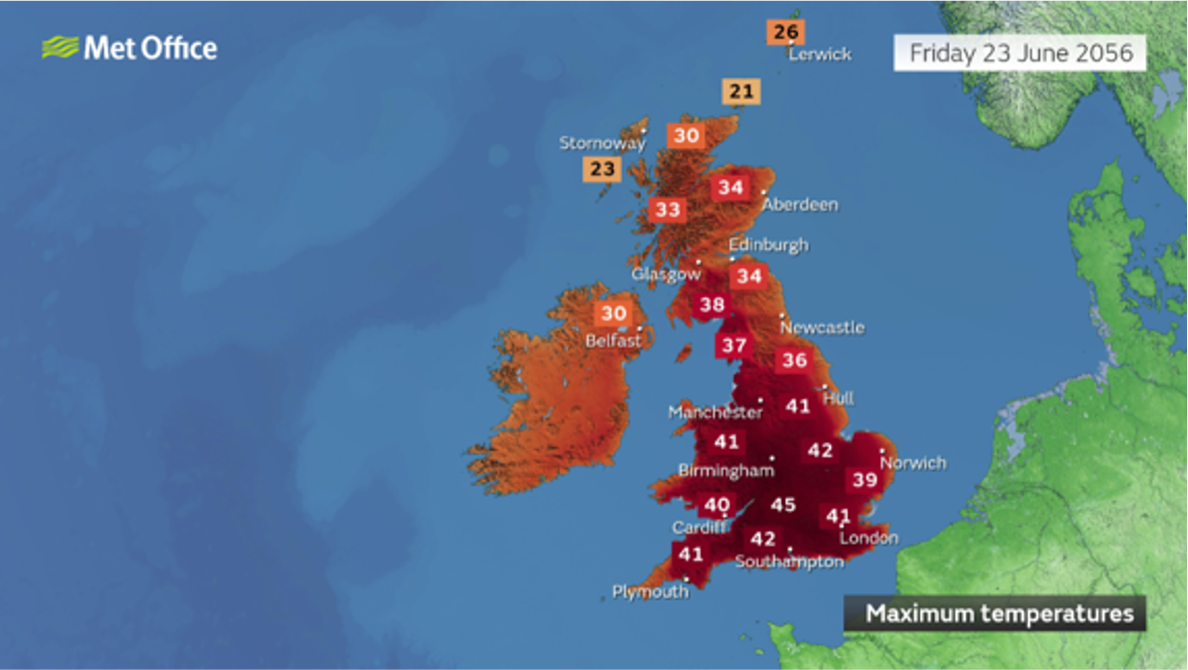
Above: Just as the summer of 2026 was heating up, the Met Office published a hypothetical weather map for 20-years hence where daytime highs might regularly exceed 45ºC.
Record breaking heatwaves
By 2056 the Met Office believe we will be experiencing maximum temperatures of 45ºC.
In 1976, the UK experienced a record-breaking heatwave and drought.
In 2026, UK heatwave records have again been smashed. In the 20th Century it was rare for anywhere in the UK to exceed 30ºC. In 2026 we have had three heatwaves, with May and June highest ever temperature records broken and the longest consecutive days above 30ºC broken in July.

Above: The UK’s Climate Change Committee published a report in May 2026 discussing some of the latest research and evidence around a warming climate and what that might mean as outcome risks for the British Isles.
‘Lethal heat’
Extracts from A Well-Adapted UK:
“The impacts of ongoing climate change are increasingly visible in the UK. In summer 2022, unprecedented high temperatures, including record-breaking 40°C heat, caused the early deaths of over 3,000 people in England and Wales.”
“Human-caused climate change has made exceeding 40°C in the UK today at least 20 times more likely than it would have been in the 1960s.’
Pg. 16
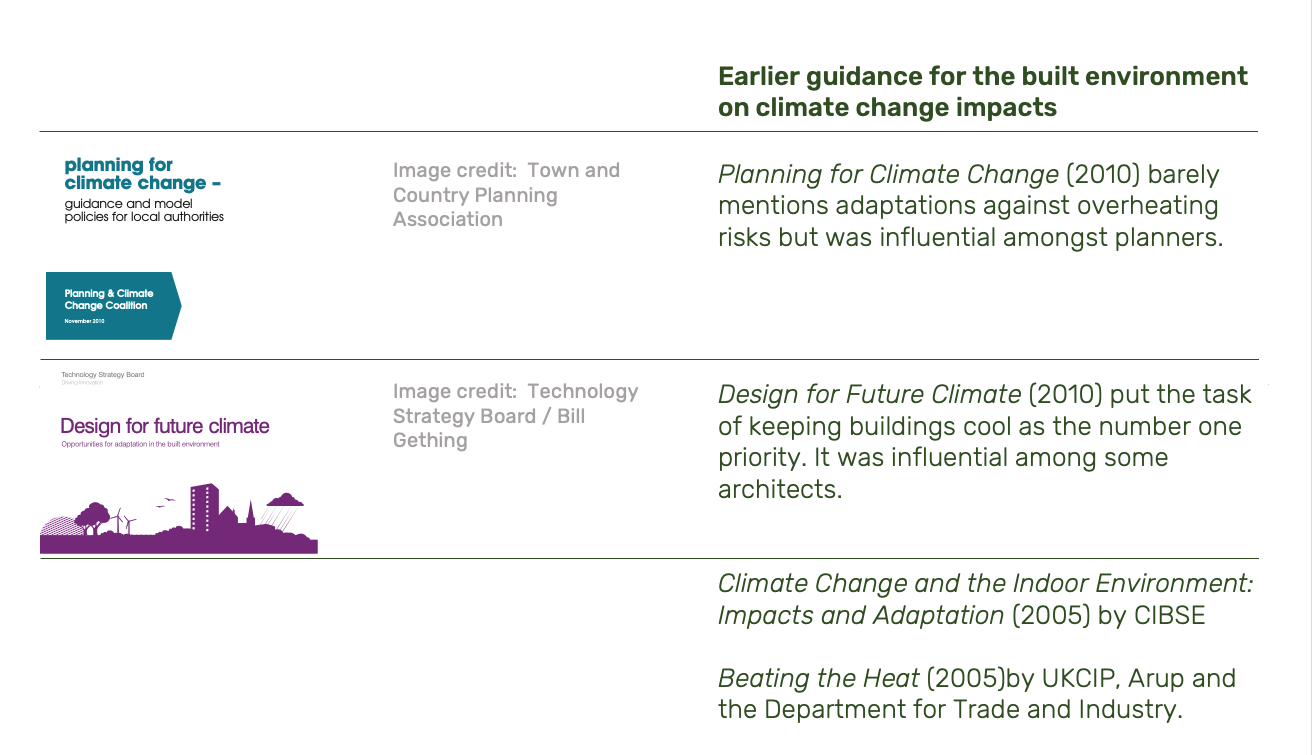
Above: Earlier publications have discussed the links between a changing climate and the human health risks associated with overheating in buildings.
Image credit: Deeper Green
Next year could be even worse for heat…
The El Niño event that is developing over the Pacific Ocean is likely to be the strongest in living memory, the Met Office has warned.
“… it is "very likely" to mean 2027 is the hottest year on record globally.”
"I have never seen an El Niño signal this intense in our forecasts."
- Prof. Adam Scaife, Met Office
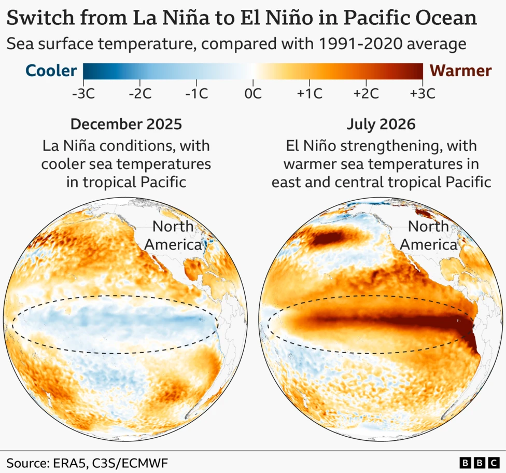
Source: BBC News, 21 August 2026
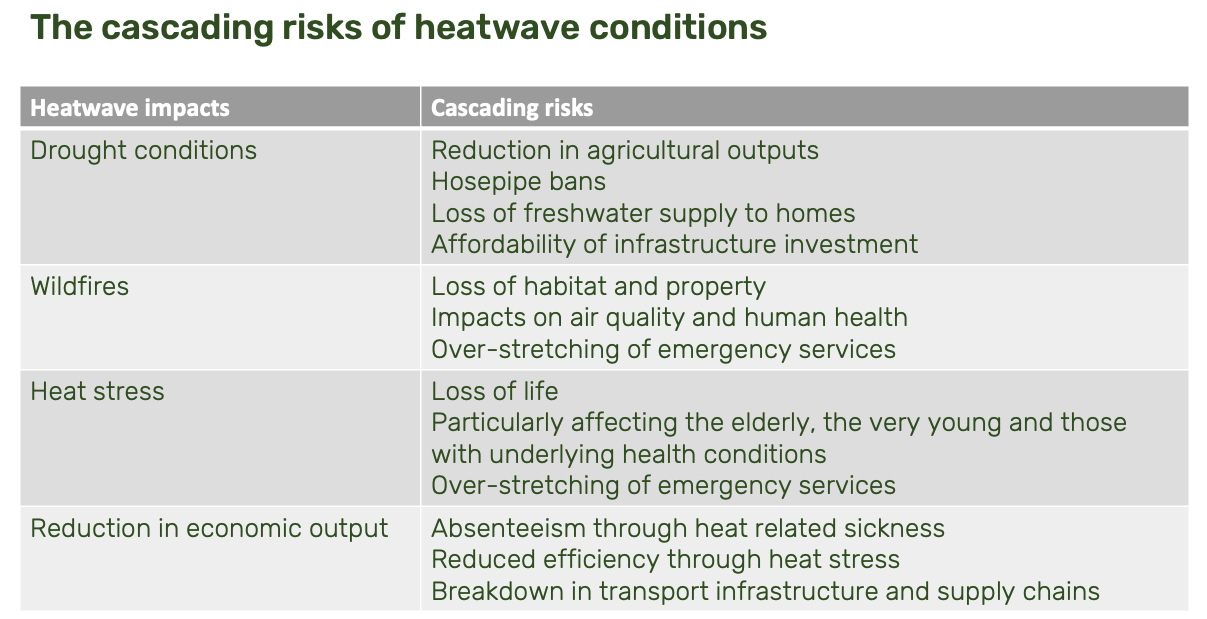
Above: Some of outcomes of prolonged heatwave conditions at a societal level. Image credit: Deeper Green
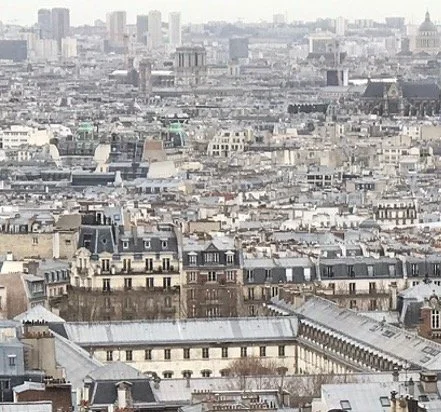
The people of Paris were particularly hard hit by the 2003 heatwave. In the second week of August, the night temperatures did not drop below 23ºC. This is thought to be one of the main causes of ‘excess deaths’ recorded at the time. Image credit: Deeper Green
What happened in Paris in 2003
Lethal heat was not considered a thing until the summer of 2003 when three consecutive heatwaves in France in June, July and August led to an estimated 19,000 excess deaths and nearly 15,000 in the first two weeks of August.
Paris was particularly ill-prepared with poor access to green and blue spaces to help cool those who could not escape the ‘urban heat island’ effect.
In the second week of August the night temperatures in Paris did not drop below 23ºC.
Could this happen to us in the south of England?
Humanity is lousy at responding to slow moving existential threats
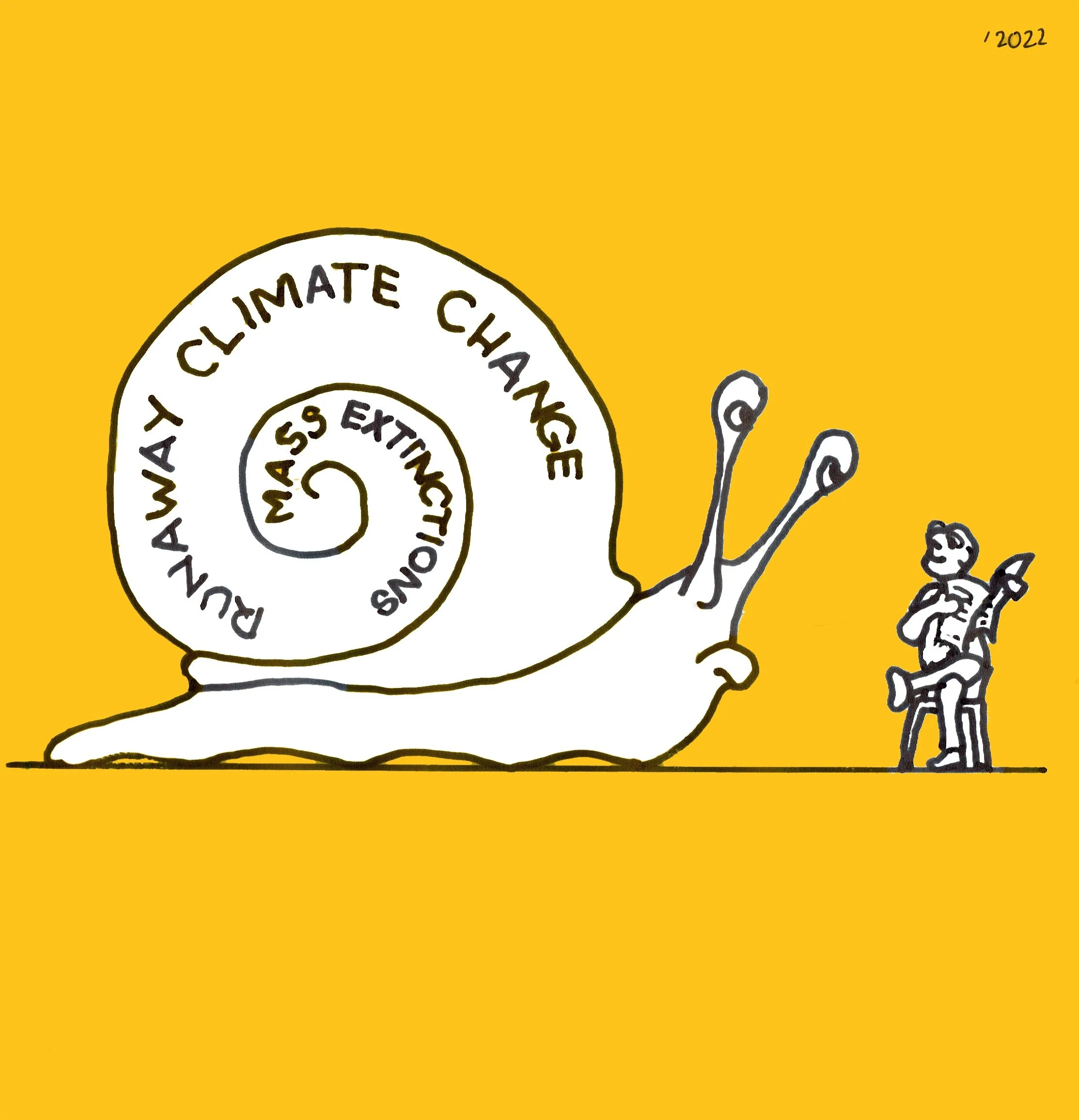
Image credit: Deeper Green
It turns out that of all the impacts of a warming climate we face, the most dangerous associated risks comes from extreme heat.
With all the other cost of living pressures swirling around us, will we, as a society or as individuals, carry out the necessary adaptations to mitigate those impacts?
Some things to know about buildings and hot weather
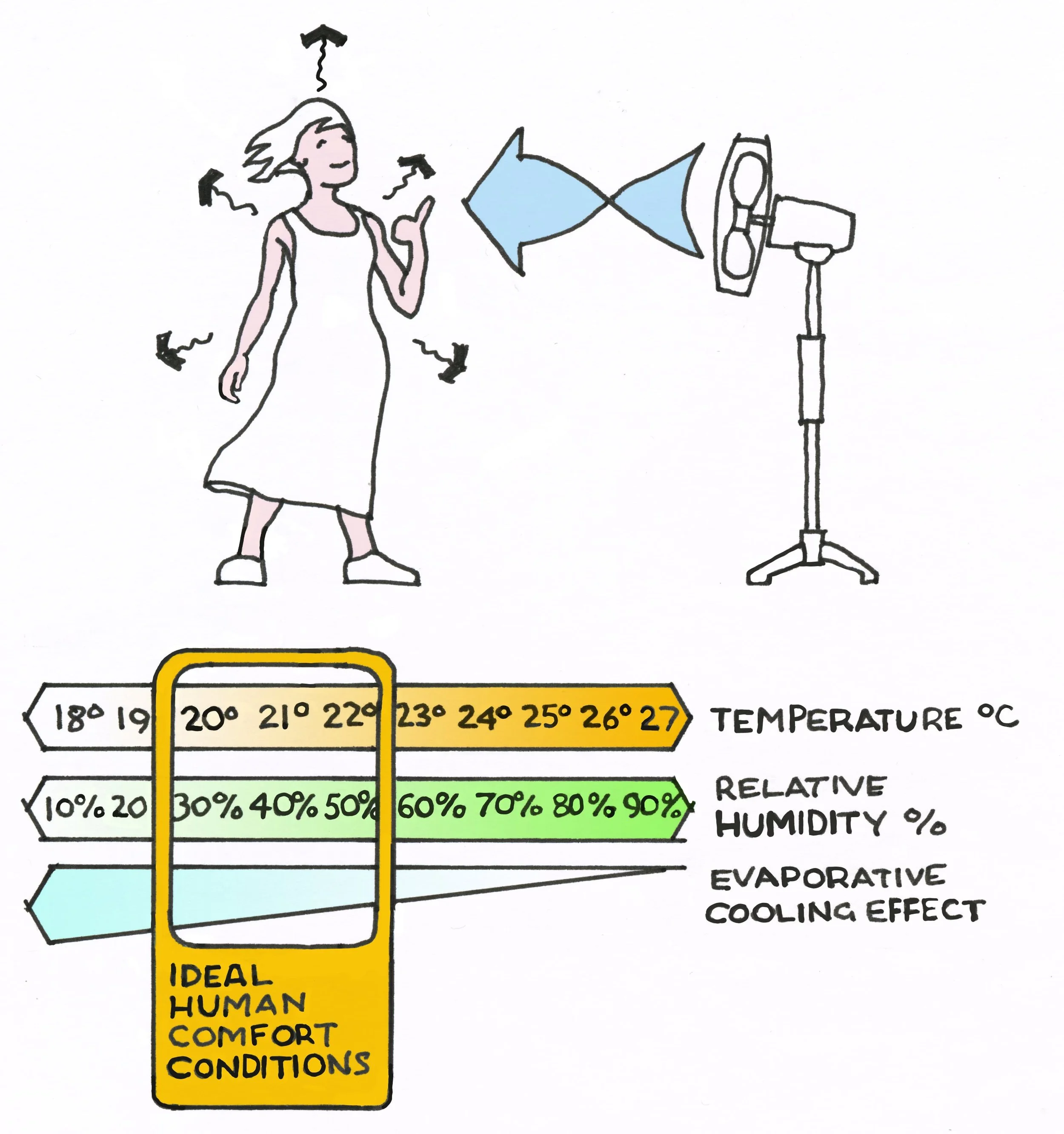
The ‘Goldilocks zone’ for human comfort is somewhere in the low-twenties degrees Celsius and between 30% and 50% relative humidity. Image credit: Deeper Green
Human comfort conditions
What are human comfort conditions?
Whilst our bodies operate optimally at between 36.5ºC and 37.2ºC, most of experience thermal comfort within a tight range of temperature and humidity.
It varies from person to person, whether we are being active or non-active and how robust our health is.
Generally accepted target interior design temperatures are around 24ºC +/- 2ºC.
Studies have shown that our tolerance thresholds for heat discomfort are roughly between 25ºC (bedrooms) and 28ºC (other living spaces).
Overheating is judged to be reached when a building exceeds these thresholds for more than 1% of occupied hours.
Source: Gething. B, Design for Future Climate (2010)
Ideal humidity levels for human comfort: 30% – 50%
In hot weather, the drier the air is, the more easily the body can cool itself through perspiration and the ‘evaporative cooling’ effect.
When high temperatures combine with high humidity (above 60% RH), the human body struggles to keep cool through sweating. This leads to heat stress with associated health impacts.
Tropical nights
Definition: A tropical night is defined as a night when the temperature does not fall below 20°C.
Source: Met Office Press Office, Understanding tropical nights and their impact (2025) [online]
The body relies on cooler nighttime temperatures to regulate core temperature and recover from daytime heat.
Our buildings also rely on overnight cooling (‘night purging’) such that the fabric of the building can perform effectively as a thermal buffer to the high temperatures during the following day.
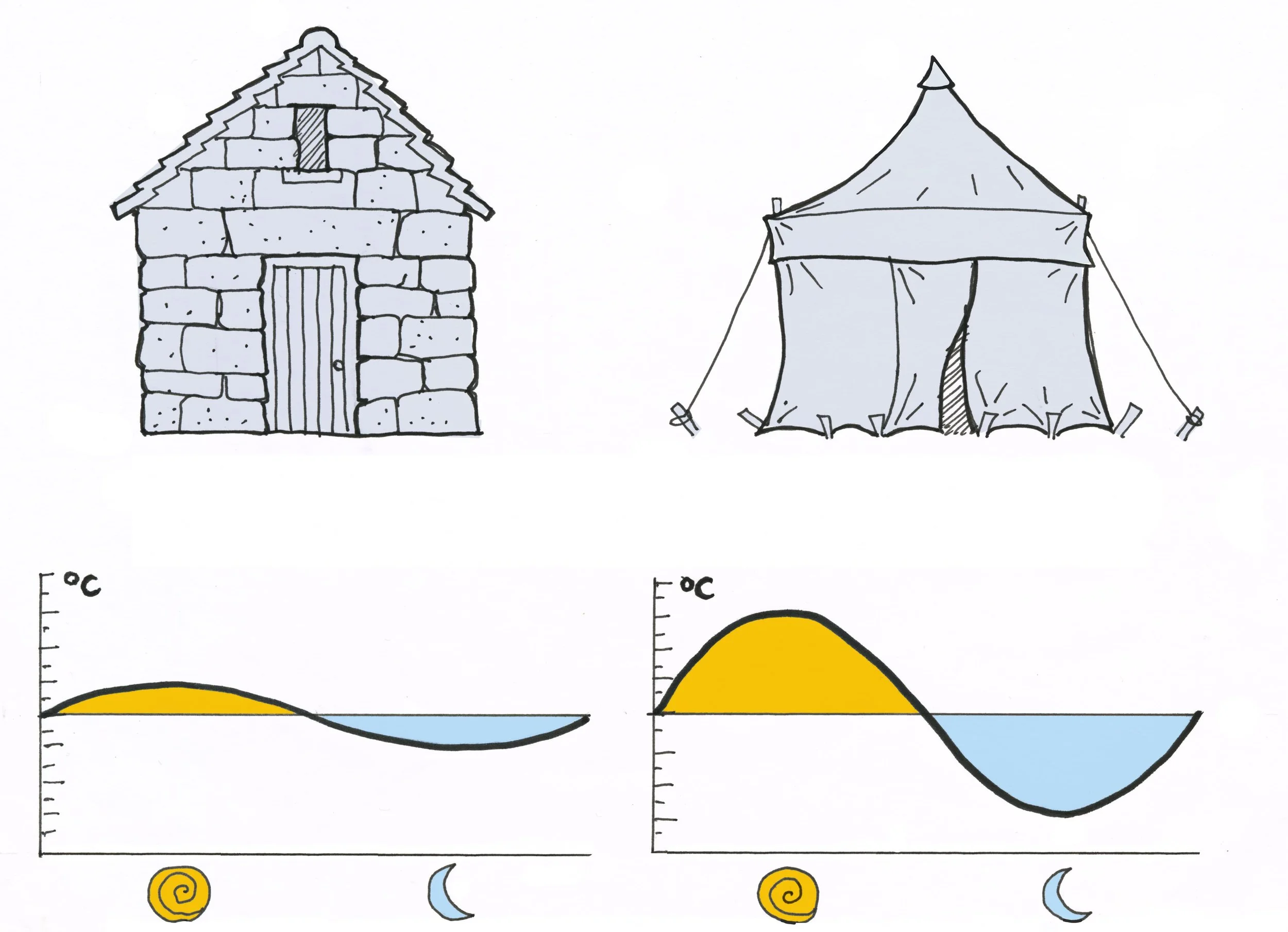
Above: Buildings of varying ‘mass’ can iron out the extremes of outdoor temperatures. Of course for human comfort, ambient conditions inside will depend on what time of year it is. Image credit: Deeper Green
Thermal mass
Buildings iron out the daily temperature swings. A building’s ‘thermal mass’ will determine how stable those temperatures can be maintained.
Depending on the time of year, ambient conditions within the building may or may not match human comfort conditions.
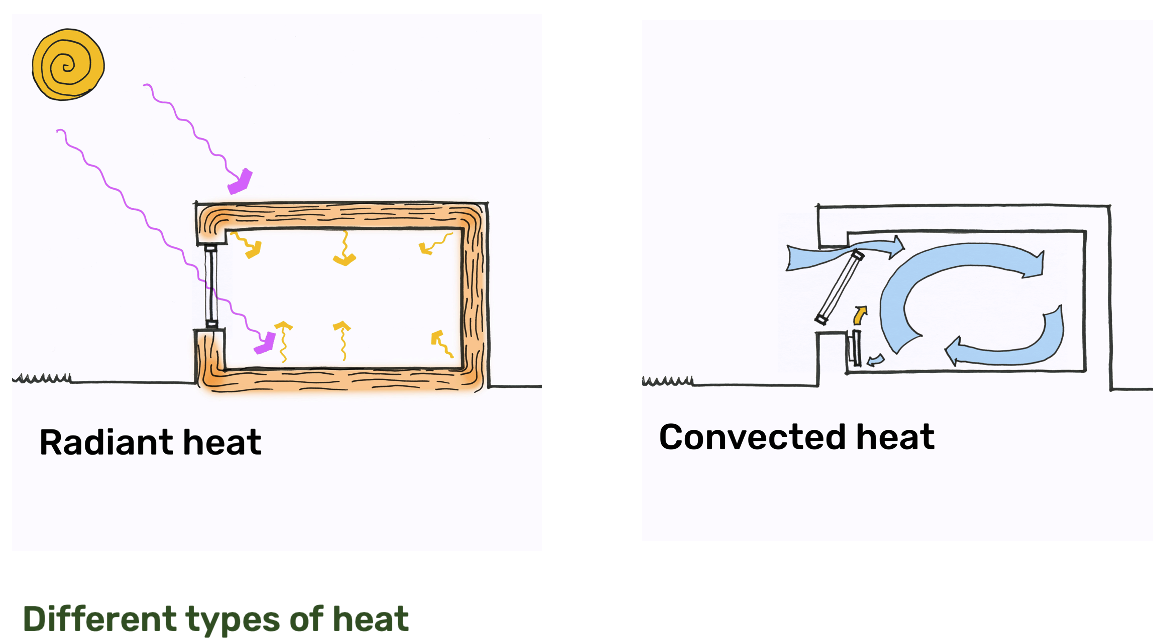
Above: We experience heat in different forms. In buildings this is either in the form of radiant heat, which is in fact an invisible energy wave, or through convected air (or other materials/matter). Radiators in buildings typically produce both radiant heat from the room-facing side of the panel and convected heat as exchanged with heat rising through the heated surfaces of the emitter. Image credit: Deeper Green
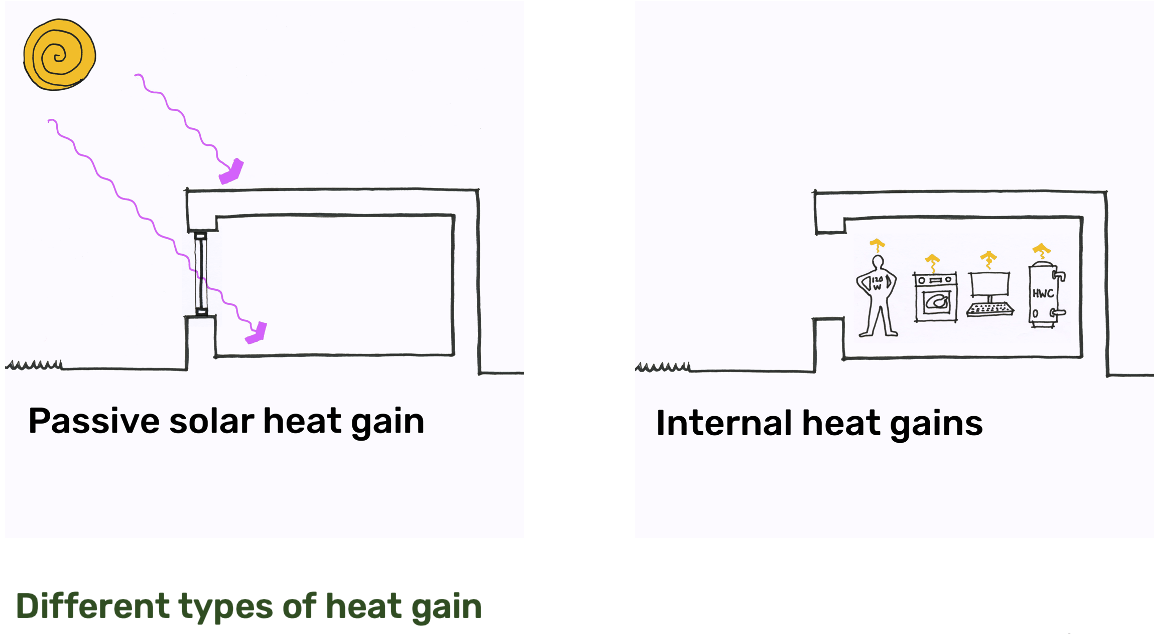
Above: Buildings and people also experience passive solar heat gain through glazing and from internal heat gains, ie. occupants, cookers, computers and hot water cylinders. Image credit: Deeper Green
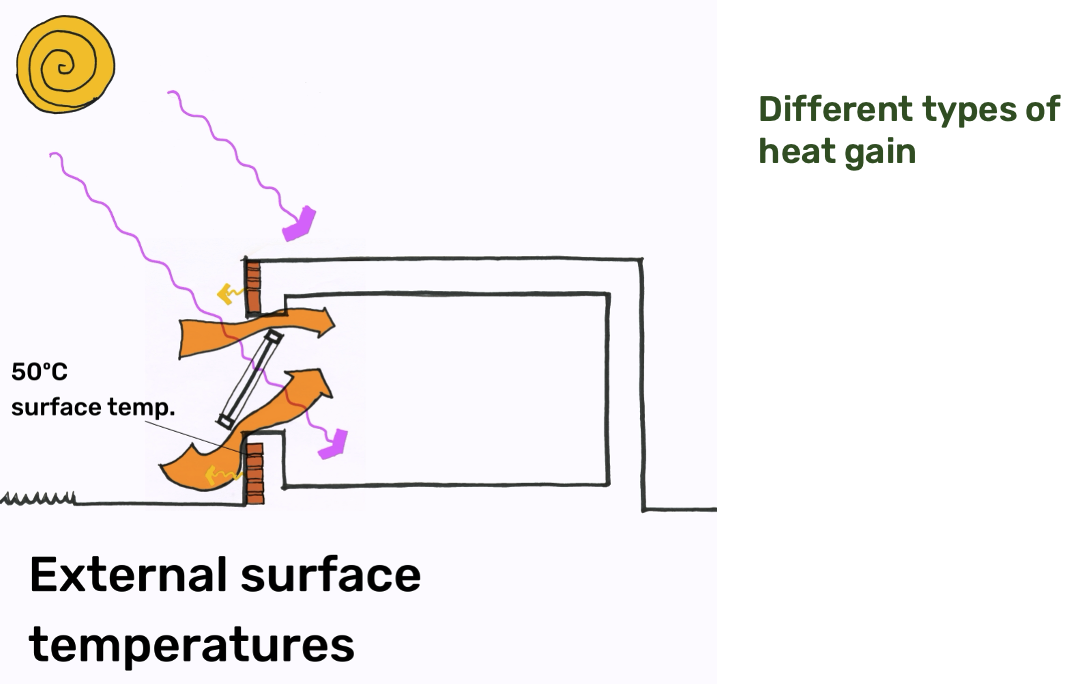
Above: External surfaces which absorb the sun’s radiant heat energy can reach very high temperatures (40ºC – 60ºC are not uncommon in summer) and in turn this creates an envelope of heated air. Unfortunately, opening windows and doors simply lets this super hot air into the internal spaces. Image credit: Deeper Green
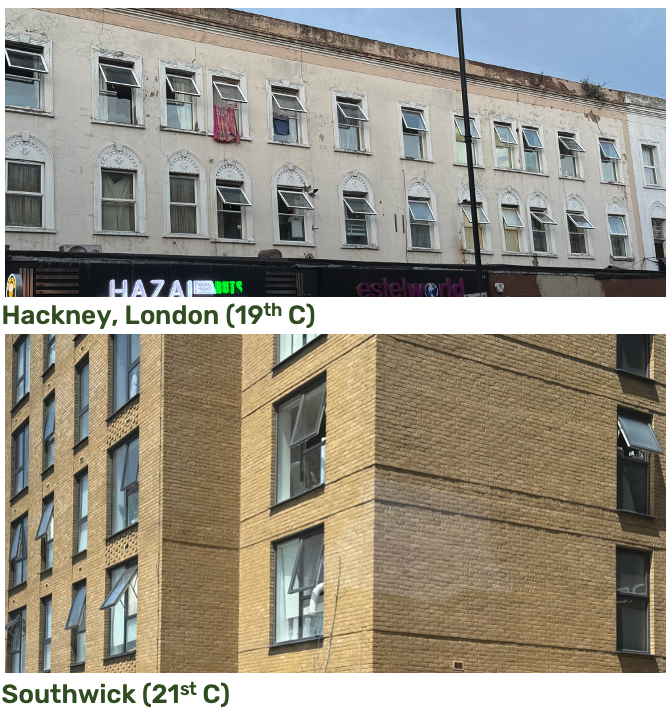
Above: These two images were taken during the summer heat waves of 2026. Both buildings show flatted accommodation with windows open but letting in exceptionally hot air (partly heated by the energy stored by the surrounding building surfaces). Image credit: Deeper Green
Hot air envelope
The Albedo effect coupled with material heat absorption can lead to higher air temperatures on the sunlit sides of buildings – great in the heating season but unhelpful in a heatwave.
Flatted accommodation, especially single-aspect flats are particularly susceptible to overheating.
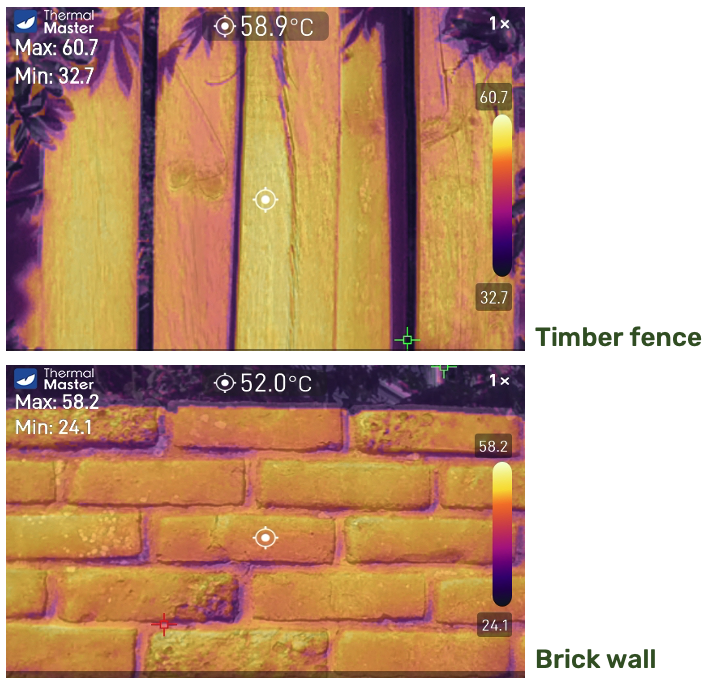
Thermal imaging reveals surface temperatures of materials exposed to the sun well in excess of 50ºC.
Image credit: Deeper Green
Orientation and solar shading
Horizontal solar shading works great on south-facing glazing but not so well for east or west-facing.
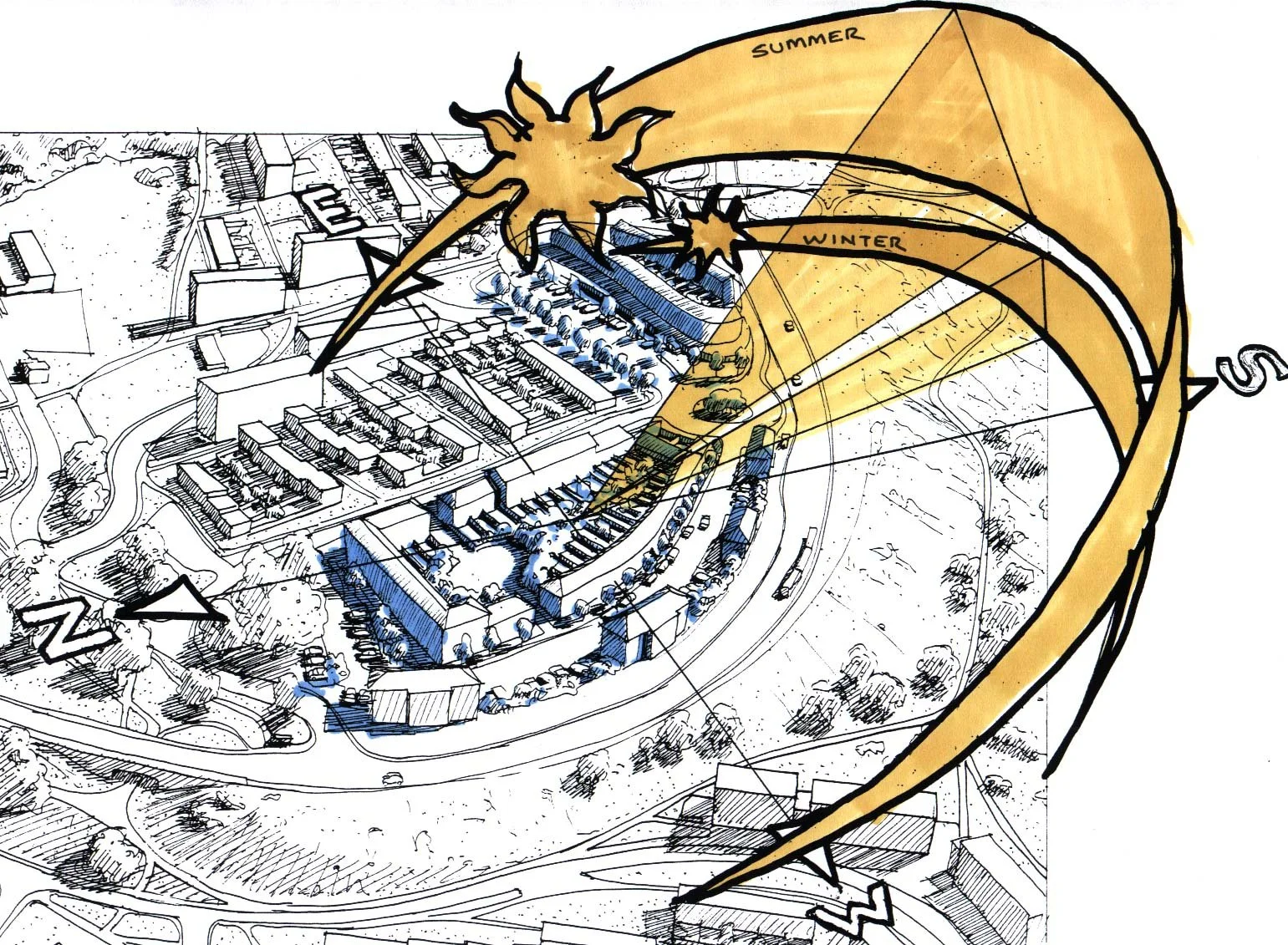
Above: Building designers have to consider how the sun moves around a building through the day and through the year. Different shading solutions maybe needed for south-facing facades relative to east or west-facing elevations. Image credit: BBM Sustainable Design
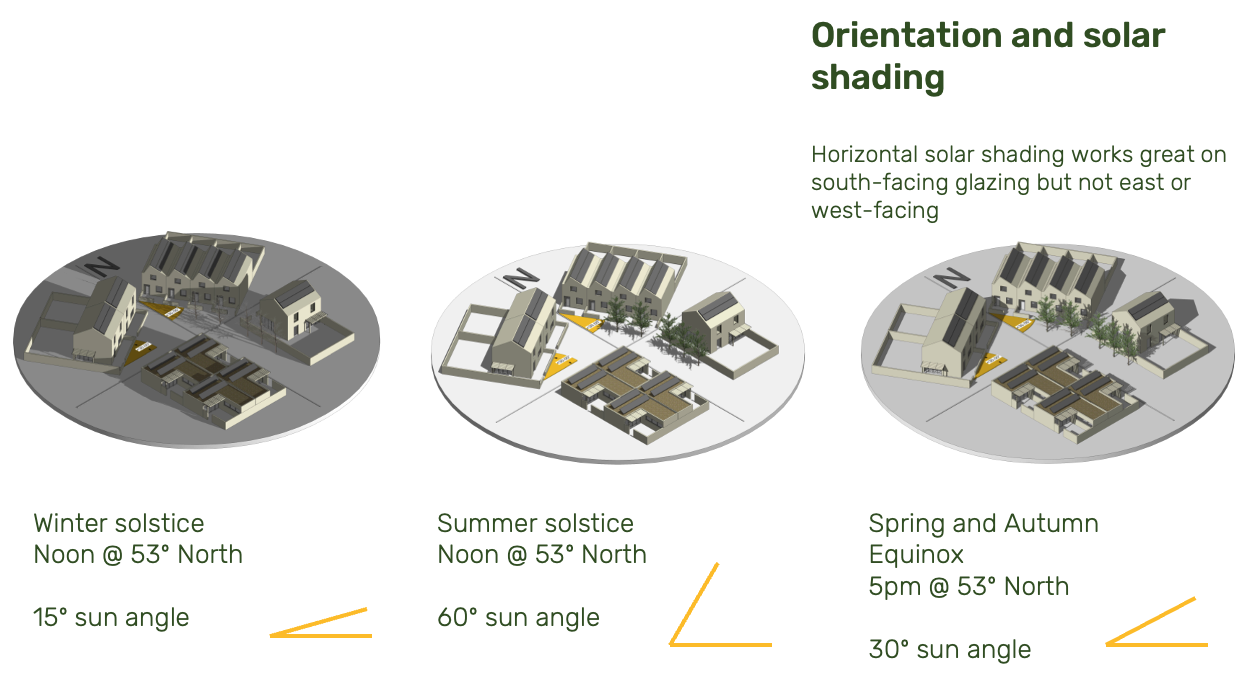
ABOVE: Horizontal solar shading works great on south-facing glazing but not east or west-facing. Image credit: Deeper Green
Things we can do to keep our buildings cooler
Modifying extremes through design
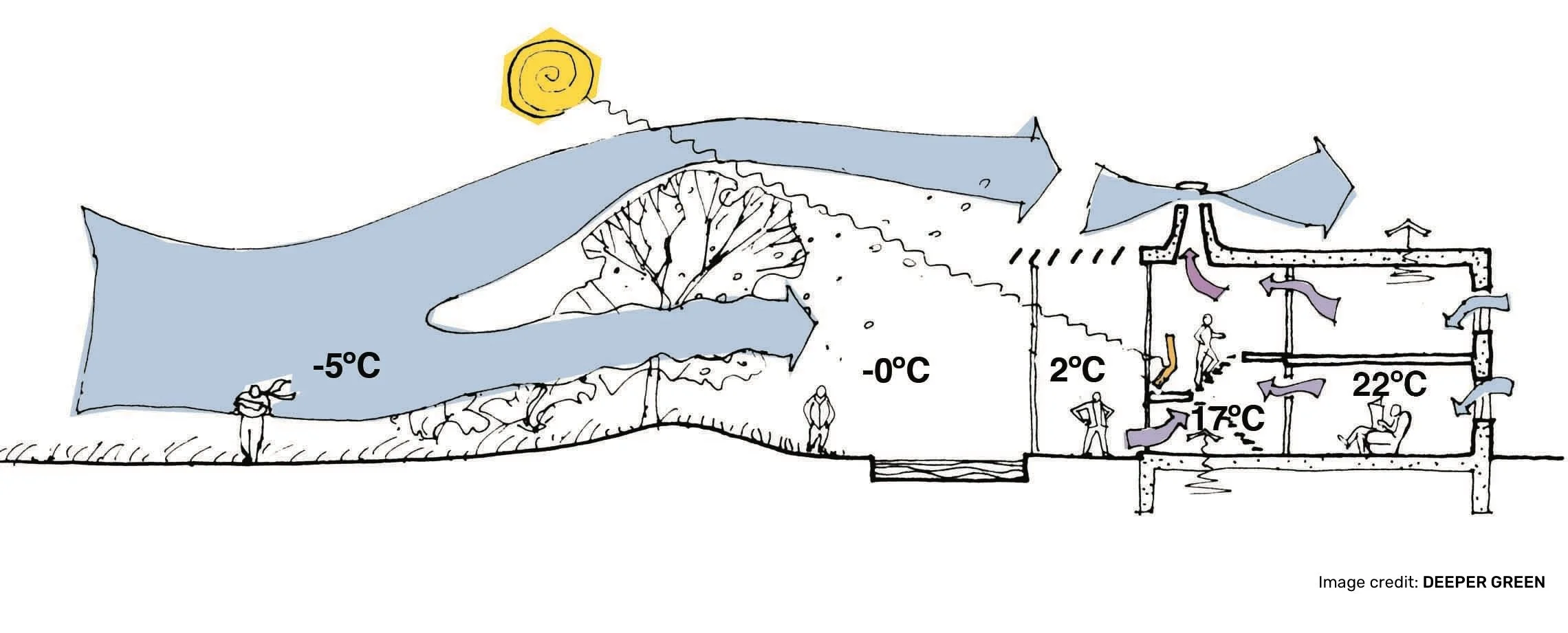
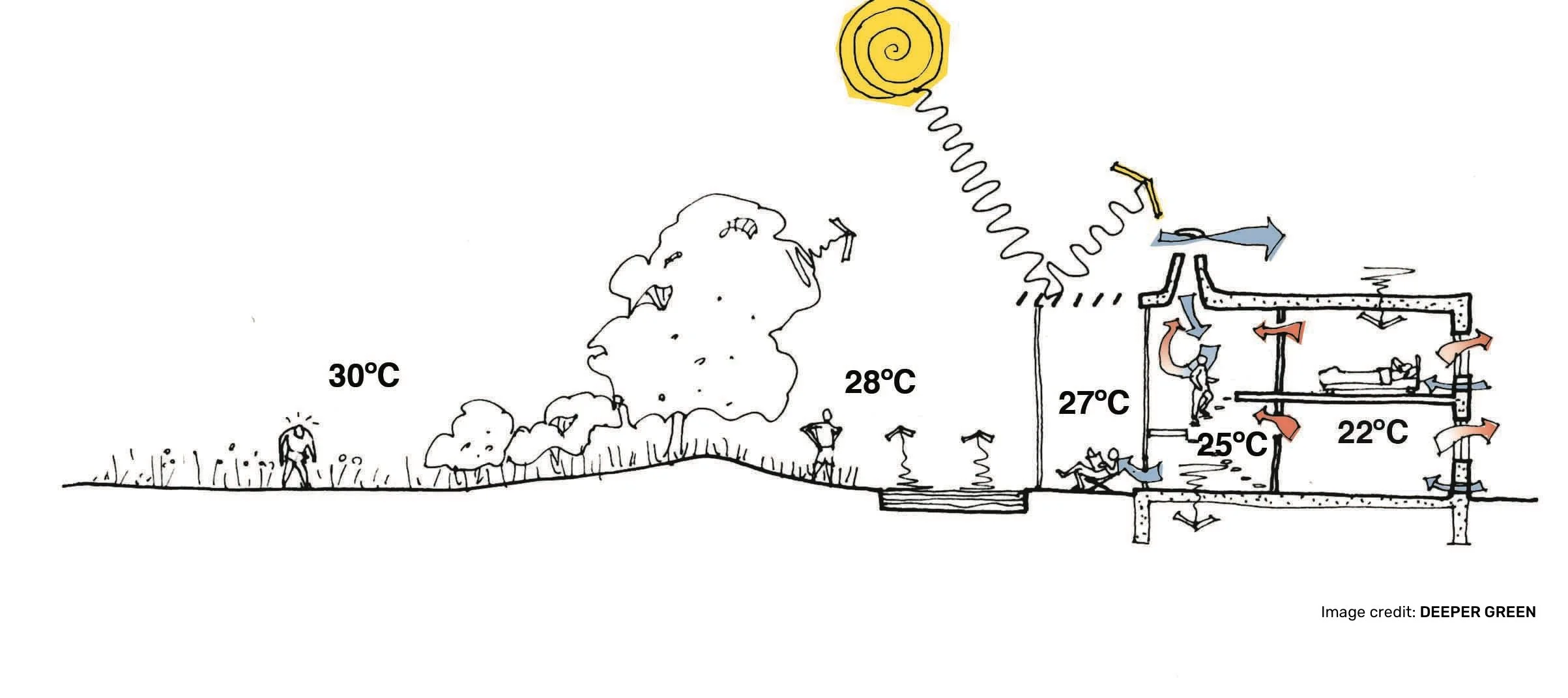
Top: Climate defensive layers employed to modify the extremes of climate in winter mode.
Bottom: Climate defensive layers employed to modify the extremes of climate in summer mode.
‘Climate defensive layering’
Through carefully chosen technical tweaks it is possible to achieve human comfort conditions with little or no active conditioning (heating or cooling systems).
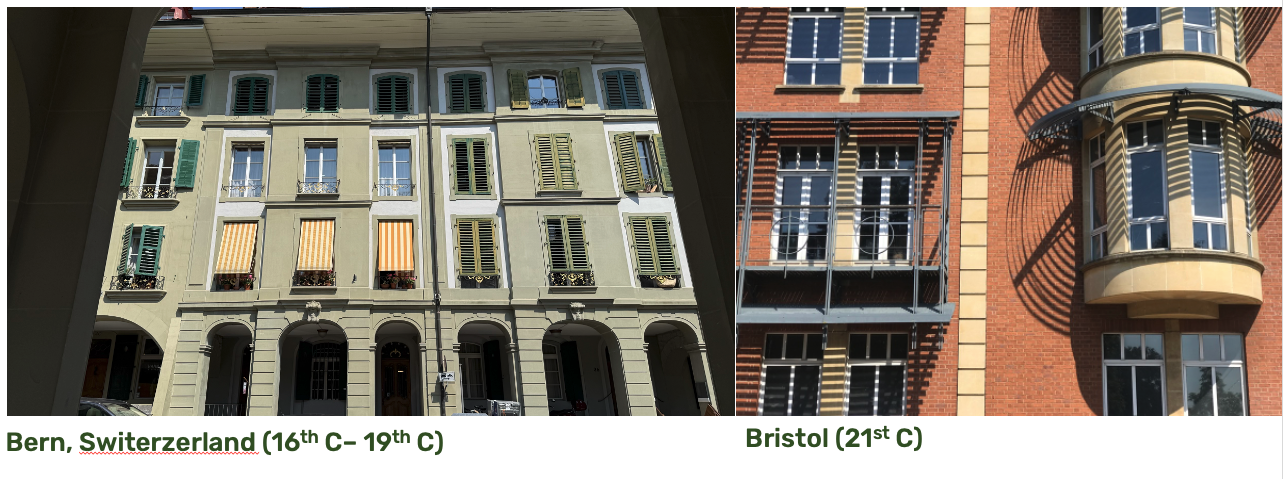
Image credit: Deeper Green
Traditional and contemporary mitigation of solar gain on buildings
Deep overhangs
Window shutters
Acrades
Brise soleil
Pergolas
What you shouldn’t do on a hot day (30ºC+):
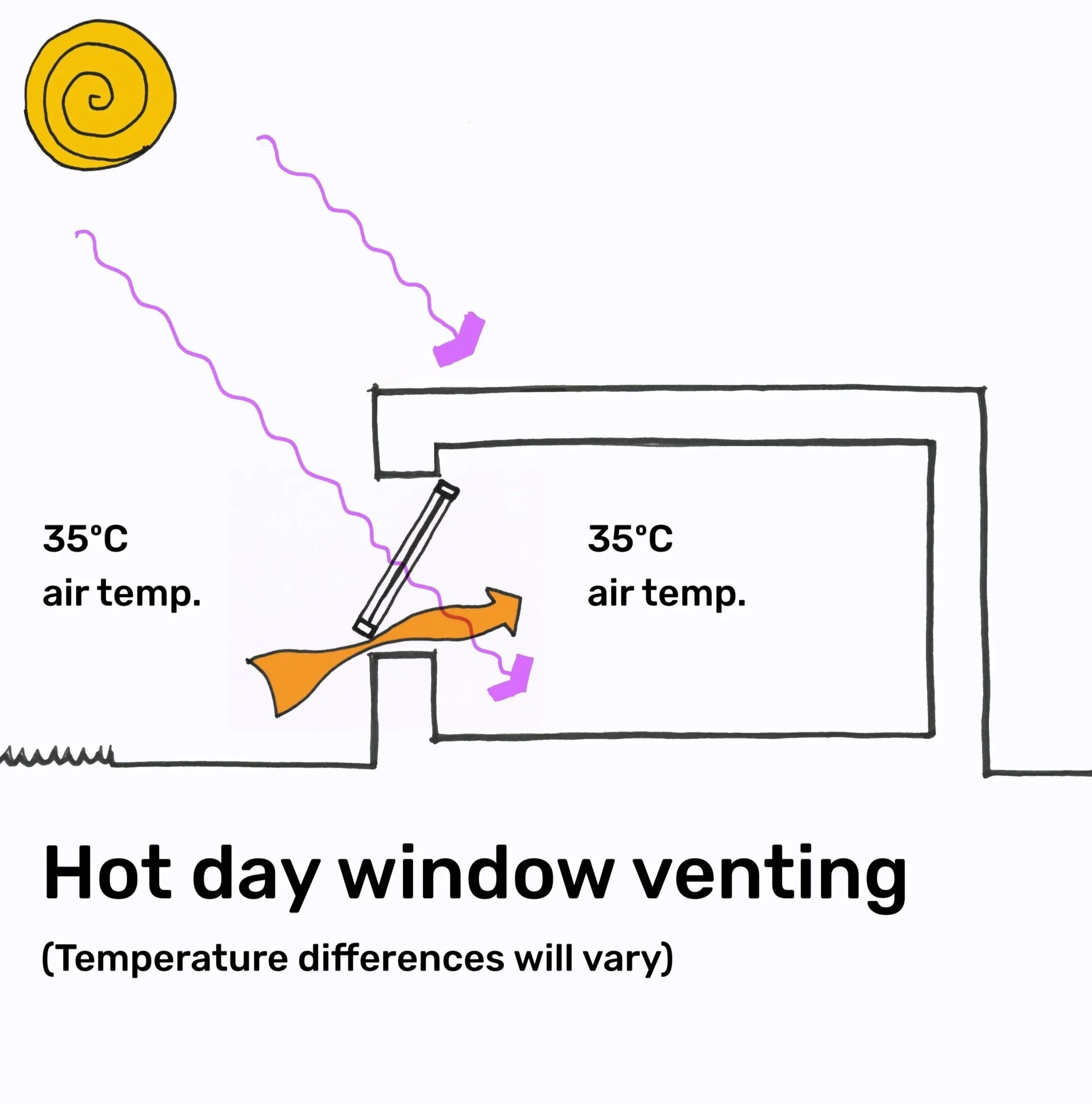
Above: It maybe counterintuitive but don’t let the hot air in! Image credit: Deeper Green
What you should do on a hot day (30ºC+):
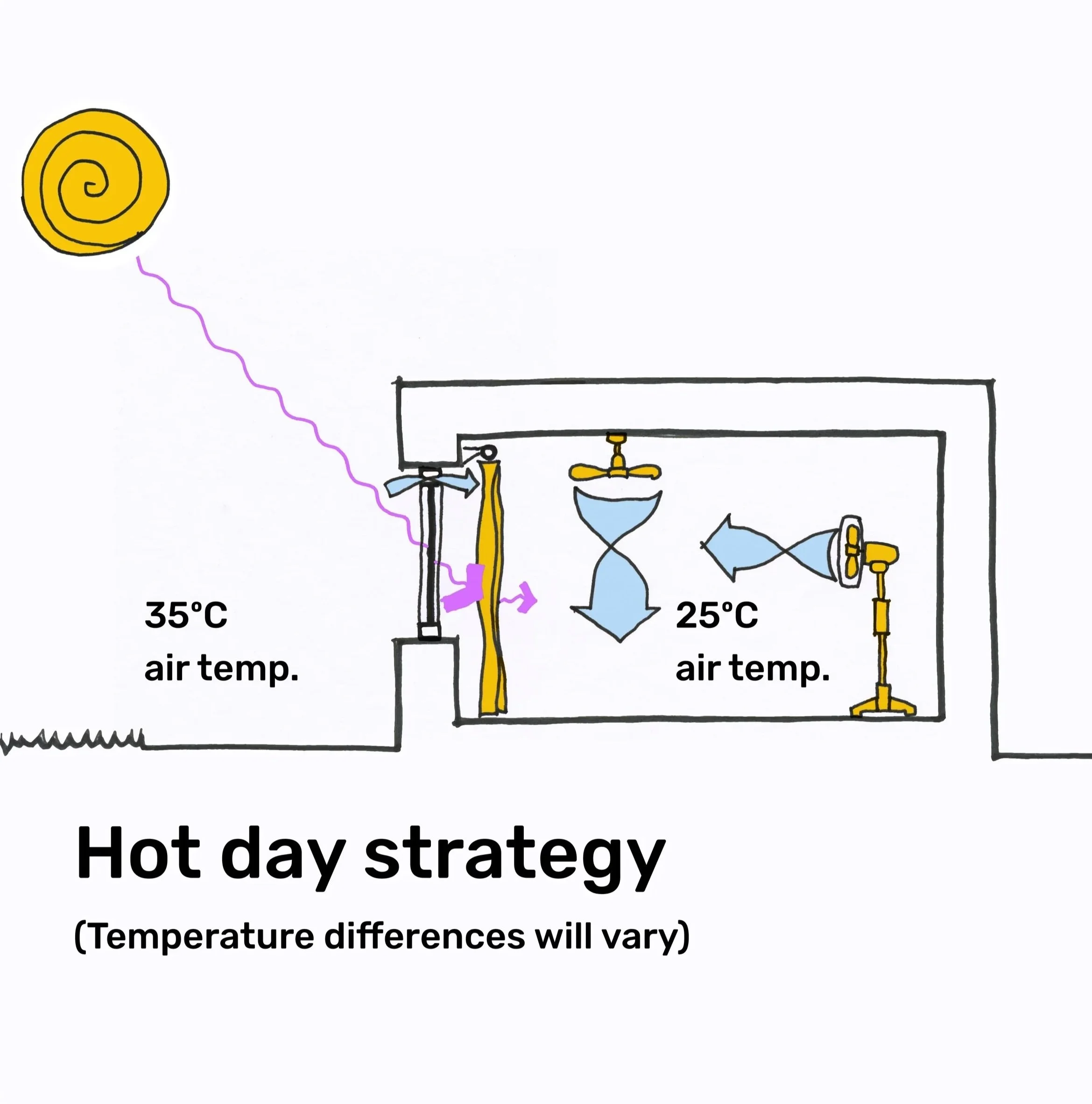
Above: Close windows but ensure you have them venting (trickle vent or night latch position) – you still need replacement fresh air. Close curtains or blinds. Use a fan internally to get some air movement going. Image credit: Deeper Green
External shading to glazed openings:
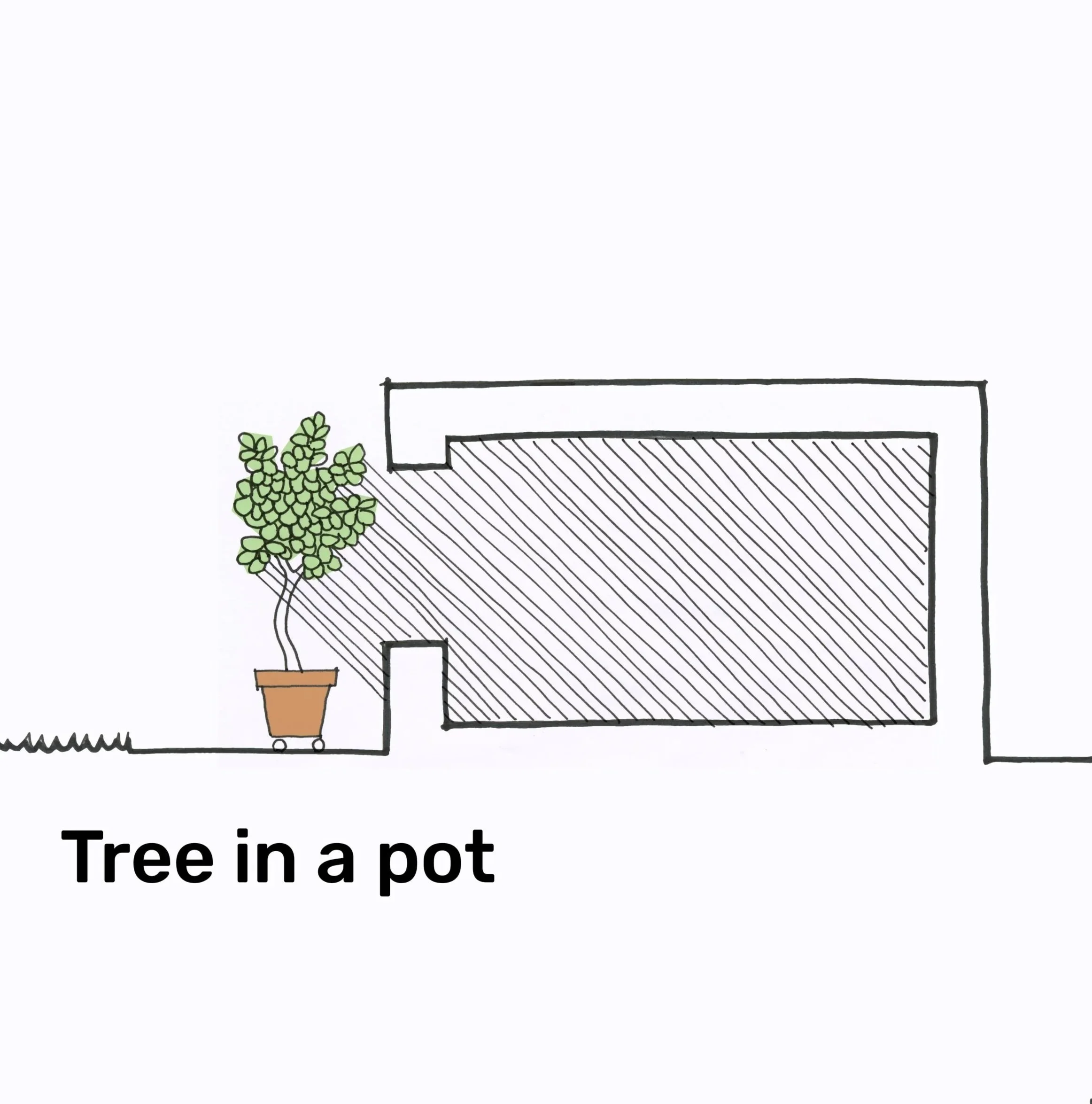
Image credit: Deeper Green
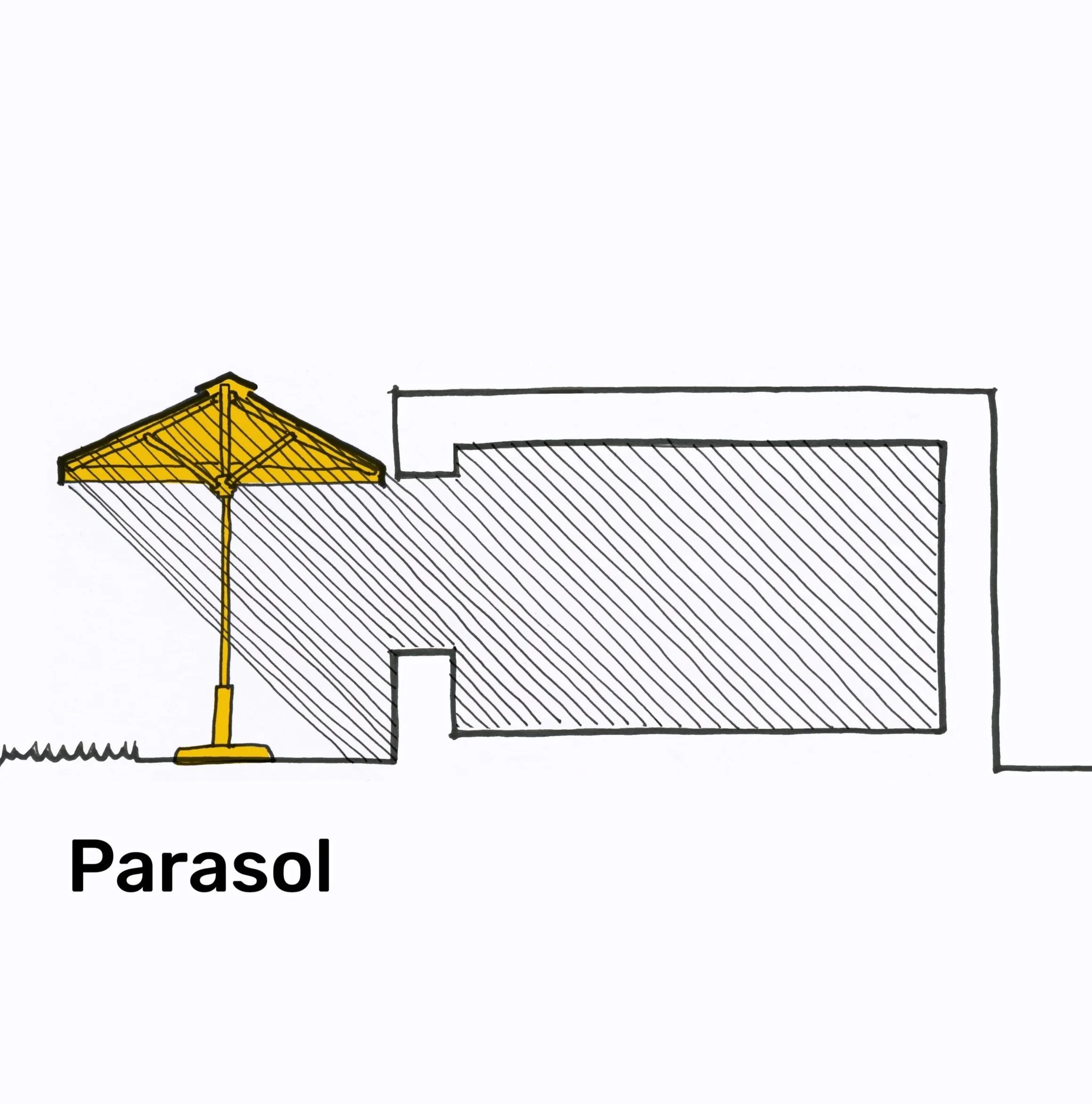
Image credit: Deeper Green
External shading to glazed openings
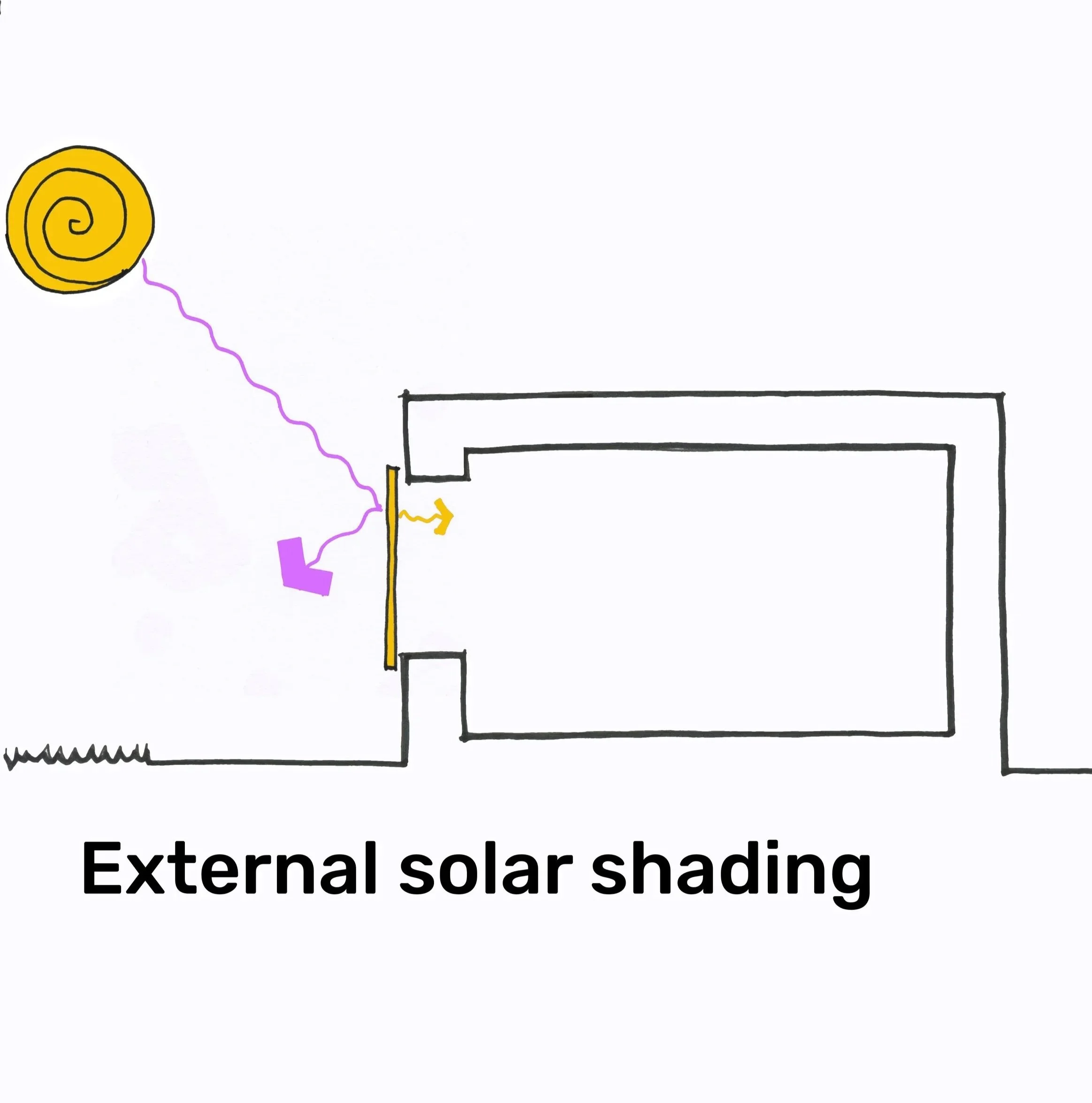
Image credit: Deeper Green
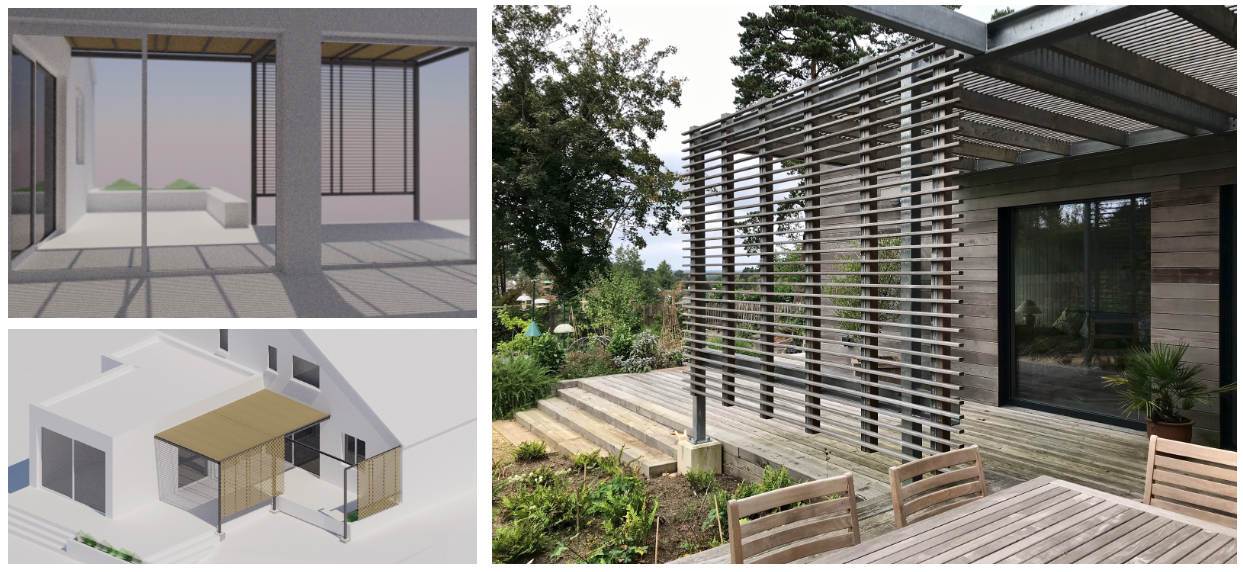
Above: Geo-referenced 3D CAD modelling was used to test varying shading solution to south and west-facing glazing on this new-build house project. The west-facing glazing actually needed some form of vertical brise soleil to intercept low-angled summer sun from mid to late afternoon. The pergola design also extended the times when for convivial use of the terrace. Image credit: BBM Sustainable Design
What you should do at night during a heatwave:
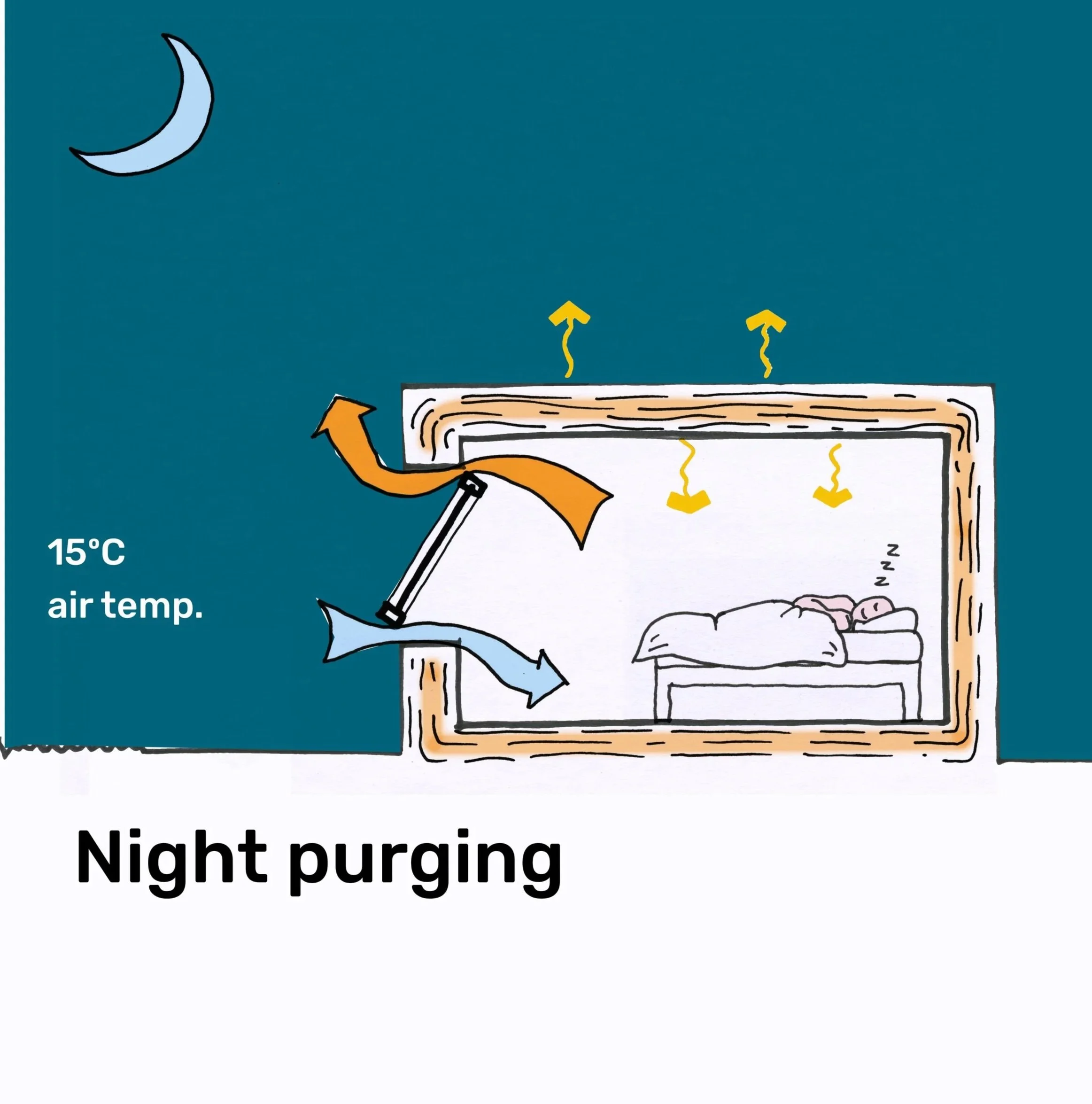
Above: So long as the nights are cool, open windows (and doors if safe to do so) to let as much heat out and bring cool air in. You are trying to cool the structure down as much as possible before the heat of the following day. Image credit: Deeper Green
Tropical nights:
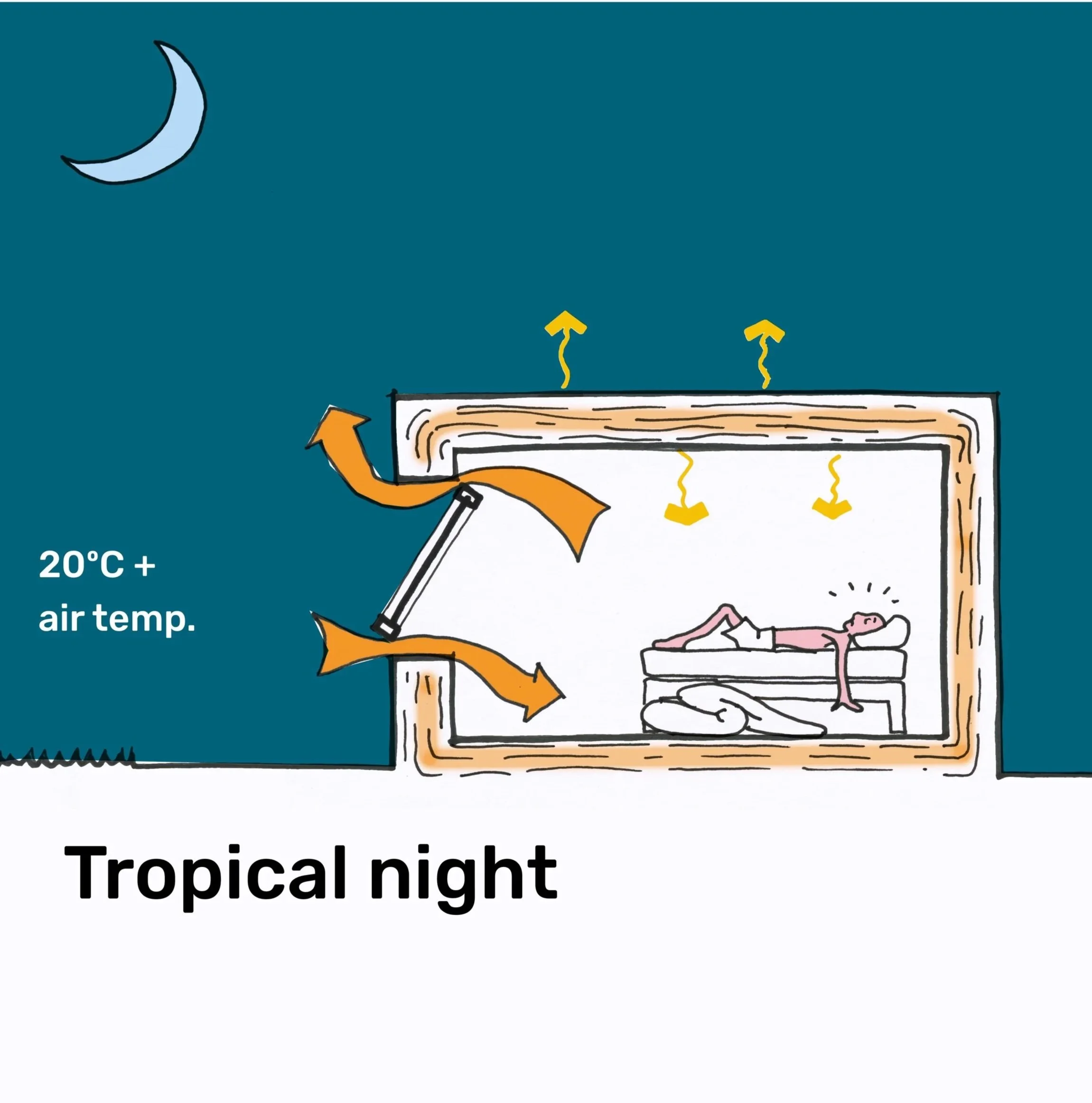
Above: Night purging has limitations when nighttime lows are 20ºC or above, so called ‘tropical nights’. When outside temperatures remain high at night it becomes increasingly difficult to purge the heat out of the building in readiness for the high heat of the following day.
Image credit: Deeper Green
SO, WHAT’S TO BE DONE?
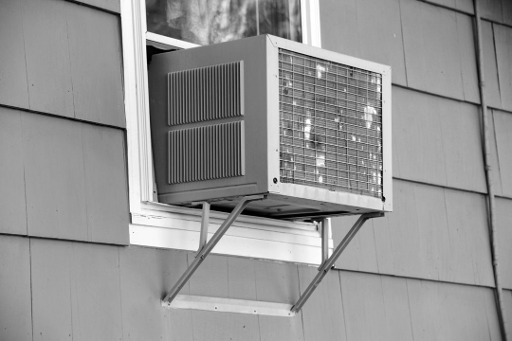
Above: Old-style individual room air conditioning unit – originally launched in 1931
Image credit: Pinterest
Comfort cooling
AKA air conditioning, comfort cooling is about supplying chilled air into a building normally using a fan convector (ceiling or wall-mounted) with an external heat exchange unit blowing the extracted heat to the outside. With the proliferation of solar electric panels, many properties can now be cooled with their own carbon-neutral energy generation.
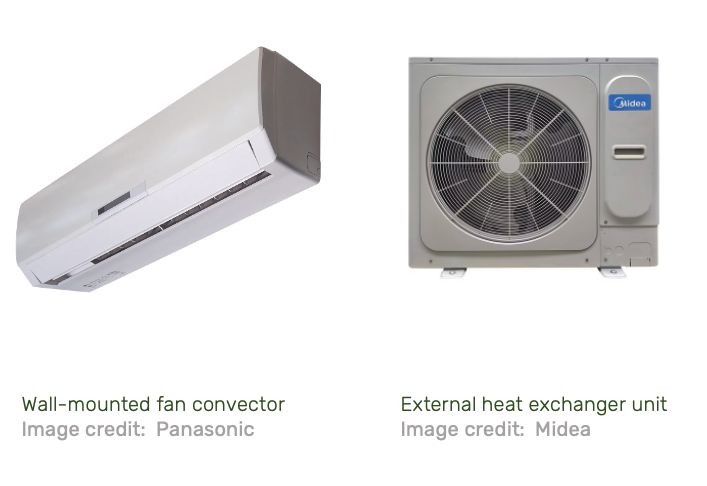
Above: In the modern era, comfort cooling now comes in the form of heat pumps which work in conjunction with fan convectors which can be mounted on walls, ceilings or even in the base of kitchen units.