
Sustainababble

The Limits to Growth; 50 Years on
On the day of the UK’s ‘mini budget’ and its renewed drive for economic growth, Deeper Green takes a look at The Limits to Growth which was published 50 years ago and discovers just how close we might be to peak planetary exploitation.

Above: Based on the ‘Standard World Model’ generated by the 1972 Limits to Growth study looking into the ‘predicament of mankind’ and the boundaries of our host planet, this image adds the extra dimension of Earth’s carrying capacity (in yellow) which is decreasing rapidly under the strain of exponential growth in human impacts. Image credit: Ian McKay / Deeper Green & Meadows et al., The Limits to Growth, 1972.
“Anyone who believes that exponential growth can go on forever in a finite world is either a madman or an economist.”
Ken Boulding, Economist[1]
Introduction
It was originally ridiculed when it was published in the Spring of 1972 and certainly stirred-up controversy in economic and political circles, but, with fifty years of accrued data to verify its validity, The Limits to Growth (LtG) report must surely be seen as the ‘canary in the coalmine’ of neoliberal growth-based economic theory. The fiftieth anniversary is incredibly poignant, if a little foreboding, as one of its twelve scenarios is proving particularly accurate in defining our times and what might be about to happen. All over the world, people are dusting off their old copies of LtG and reappraising its stunning foray into systems thinking and planetary modelling as well as recognising its importance for societal decision-making. It has been periodically revisited by its own authors and independent experts but its message now, horribly fulfilling its predicted phenomena of ‘decision delay’, means that its twelfth scenario, where we could have achieved an existential equilibrium with our host planet is no longer available to us and we are almost certainly poised for a chaotic epoch of collapse rather than a well-planned descent.
The Limits to Growth was a report which looked into possible future scenarios for humankind’s existence on planet Earth, ‘the predicament of mankind’. It was commissioned by a collective of like-minded thinkers instigated by Dr. Aurelio Peccei, an Italian industrial manager. The group would go on to form the Club of Rome. Their first major gathering was in 1970 in the ‘eternal city’, thus the name. Their guiding pursuit was the, “…objective, scientific assessment of the impact of humanity’s behavior and use of resources”[2]. One of the members, Jay Forester, a systems professor at MIT, offered to build a computer programme with colleagues to test human impacts against the planet’s ability to sustain. The team chose five data sets including:
— population
— agricultural production
— non-renewable resource depletion
— industrial output
— pollution
The programme they built became known as ‘World3’. It was then loaded with historical data dating from 1900 through to the early 1970’s. The output graphs of each scenario show the unmistakable upward and downward trends of the basic five criteria and then the predictive modelling takes over with curving trend lines giving us possible glimpses of our future out to the year 2100. Twelve different scenarios were tried out with variations of decision making, population control, resource availability and technological advances forming the inputs and based on what could reasonably be estimated at the time. All but one scenario showed exponential growth in human impacts and reduction in planetary resources then leading to an ‘overshoot’ of the Earth’s carrying capacity. This is then followed by a descent or collapse of first food production and industrial activity and then population decline. The book concluded, “Our goal was to provide warnings of potential world crisis if these trends are allowed to continue, and thus offer an opportunity to make changes in our political, economic, and social systems to ensure that these crises do not take place.”[3]
The findings of the report became a book which would go on to sell millions of copies. The authors were Donella H. Meadows, Dennis L. Meadows, Jørgen Randers and William W. Behrens III.
How well did World3 predict the future?
Dennis Meadows, one of the original authors, writes in the 2022 publication, Limits and Beyond[4], that many experts have observed that one of the twelve scenarios “…tracks historical data reasonably well”. He refers to Figure 35 which shows the ‘Standard World Model’ whereby the data inputs assume, “… no major change in the physical, economic, or social relationships that have historically governed the development of the world system. All variables plotted here follow historical values from 1900 to 1970. Food, industrial output, and population grow exponentially until the rapidly diminishing resource base forces a slowdown in industrial growth. Because of natural delays in the system, both population and pollution continue to increase for some time after the peak of industrialization. Population growth is finally halted by a rise in the death rate due to decreased food and medical services.”[5]
Notably, World3 does not track an estimation of the planet’s carrying capacity or the sustaining potential of the biosphere which of course is being inexorably reduced by human impacts. Nor does it model climate change. Such phenomena were barely coined or indeed understood back 1971 so the datasets used were purposefully simplified to the direct interactions between human living systems and the planet. Maybe diagramme 35, familiar to LtG readers, should be updated to show this other dimension (see lead illustration above).
The recent revisiting of LtG and World3 has identified that resource depletion rates have been extended further into the 21st Century than foreseen in 1972 and thus the pollution effects become the predominant limiting trend. “Currently, 50 years after the publication of the 12 LtG scenarios, it appears the “resource crisis” is less likely than the “pollution crisis”.[6] Some cite that the predicted population descent will also be offset but in this instance it is an increase in death rate of other species. For some years now we have been declaring mass extinction events around the world and much of this is being caused by climate change and the human destruction of natural habitats to make way for more mechanised human food production.
Another important message set out in LtG was that no matter how they tweaked the data, be it finding extended resource availability or discovering new technologies to mitigate environmental impacts, these variations merely changed the date of peak planetary exploitation with the population descent always following. That is except for one scenario tried. This one was called ‘Global Equilibrium’. In this version of the modelling, strict birth control measures were put in place by 1975, policies imposed to control per capita material consumption and technological advances brought in to help us be more efficient with energy and resources. The resultant projections described a ‘steady state human system’. In modern parlance, it achieves a societal ecological footprint within Earth’s carrying capacity. If we had taken these steps nearly fifty years ago, equitably applied global living standards might be like that of Italy or South Korea as they are in 2022, according to Dennis Meadows.[7] According to LtG, a truly sustainable global society will require both technological advances and behaviour change.
The Limits to Growth also consciously left out war in its modelling. Ironically, it is Putin’s invasion of Ukraine which has given us a dress rehearsal of what it will be like when resource supply drops significantly below demand. These are the downward trends which lead to population decline in the LtG models. We are poised for our first post-invasion northern hemisphere winter. We will see hardship on a scale not seen for many decades in poorer countries and even more plundering of the ‘magic money tree’ in the developed economies as we try to hold off decline. We will see business models, services, product offerings and shopping baskets being re-thought in a new paradigm where we must make things work with less energy and resource consumption per capita.
Making fossil fuel dependent practices less economic to pursue is what a carbon tax was supposed to have done on a more gradual basis to what the war in Ukraine has brought about. Unfortunately, free-world politicians have never been able to properly implement it, although in isolated instances, it has been tried. Take for instance in the UK when John Major’s government introduced the Fuel Price Escalator in March 1993 in response to public protest of the environmental impact of Thatcher’s road building programme and the realisation that exponential growth in traffic was not sustainable on a small island. The policy was to gently escalate the tax of fuel over time. It was reversed in 2000 after aggressive protesting by road hauliers and members of the public.
Russia wanted to play the west for its dependency on oil and gas but, with Ukraine also being one of the major ‘bread baskets’ of the world, the Putin government was also able to weaponise food availability. In so doing, it was messing with not one but two of the LtG trend categories.
Ignoring the message
The carriage on the roller coaster is cresting and the drop is pending. The ‘age of plenty’ is over but there are still many influential voices out there telling people what they want to hear rather than what they need to hear. If they do truly believe in ‘sustainable economic growth’ over a ‘steady state’ societal model, then they are gambling at the scale of our host planet.
In the Limits to Growth, they used the term ‘decision-delay’. The team knew geo-political policy would take time to move towards meaningful sustainable practices. They rather hoped for instance that population controls could be in place by 1975 to avoid an inevitable crash at some point in the Twenty-First Century. It is fair to say that we are globally more aware of the impacts of climate change. Being aware is one thing but unfortunately the scale of policy change simply has not caught up with the magnitude of the predicament.
Many remain unconvinced that climate change is a bad thing or that it is induced by human activity. ‘Climate change deniers’ are prevalent particularly in right-wing political circles and within the fossil fuel and associated industries. Their promise of increased prosperity is defined as greater material wealth and it’s an appealing prospect for voters.
There are other forces in society that use their corporate wealth to mislead and spread doubt by calling into question the credibility of climate change science and the work of the Intergovernmental Panel on Climate Change (IPCC). Such actions by the likes of the Global Climate Coalition and the American Petroleum Institute, whose members included major players in the fossil fuel industry, have set back real action to kerb human impacts on the planet by possibly decades.[8] In the run-up to the Kyoto climate conference in 1997, enough uncertainty about the scientific basis of climate change was spread by big industry that the US senate passed a resolution which prevented the country from signing a climate treaty and thus torpedoing much of the Kyoto Protocol’s hoped for impact on mitigating climate change. What LtG reminds us of though is that regardless of whether or not we believe “The balance of evidence suggests a discernible human influence on climate change”[9], there is no way exponential growth is supportable through the coming decades.
The IPCC has been a force for environmental responsibility across political boundaries but it has been easy prey for those who want to obfuscate the climate emergency agenda. Its remit is focused on communicating the modelling of climate change. It is looking at the symptom and leaving it up to others to address the cause. Should we not have a similar international panel and some form of global governance looking into achievable pathways to what LtG looked at in scenario 12, ‘Global Equilibrium’?
The upwards growth trend in the make-believe world of neoliberal economic thinking never had a top it. It would always be cropped out in the graph. In the real world, which happens to be a finite planet with real laws of physics, we must reject the exponential GDP growth ethic we have been sold and wake-up to the fact that we have overshot the planetary limits with this model and reached a peak of exploitation. Of course, the LtG ‘Standard World’ scenario indicated that economies would start peaking and flat lining into the 2020’s. Here in the UK, flat lining growth is not seen as reaching a planetary limit but a failure of previous policy not to have grown the economy hard enough. When Elizabeth Truss became the new British Prime Minister in September of 2022, she pledged to ‘do unpopular things’ to grow the UK economy. Times are tough and saving the planet, the slow-moving existential threat, will be moved down the political agenda yet again in favour of accelerated use of natural capital.
Where do we go from here?
To overshoot means to go too far, to grow so large so quickly that limits are exceeded. When an overshoot occurs, it induces stresses that begin to slow and stop growth. The three causes of overshoot are always the same, at any scale from personal to planetary. First, there is growth, acceleration, rapid change. Second, there is some form of limit or barrier, beyond which the moving system may not safely go. Third, there is a delay or mistake in the perceptions and the responses that try to keep the system within its limits. The delays can arise from inattention, faulty data, a false theory about how the system responds, deliberate efforts to mislead, or from momentum that prevents the system from being stopped quickly.
Donella Meadows, A Synopsis: Limits to Growth: The 30-Year Update [10]
Donella Meadows was the lead author of LtG and she revisited the original work with Beyond the Limits to Growth and then again in Limits to Growth: The 30-Year Update. These works started to look at the legacy, what the global societal responses had been and where might ‘we’ go from here. The inertia of neoliberal economic theory was more difficult to shift than the team had hoped so the more pessimistic scenarios looked the more likely of outcomes even by 1992. However, the projections of the ‘Standard’ World Model’ showed growth limits being reached in the 2020’s and then population decline occurring into the 2030’s. We are where we are and perhaps the best time to have fixed the proverbial roof has now passed.
Meadows likened the global economy to a car needing to slow down early enough to avoid a crash rather than leaving it too late and hitting a ‘brick wall’ with catastrophic consequences. Up to this point, it has been tricky for LtG converts to argue for that pre-emptive slowing down with imposed limits. The upwards growth of material wealth for all was too seductive. Supporters of the status quo have only needed to point to the unprecedented prosperity enjoyed in the developed economies since WWII to keep public opinion on-board and get themselves either (re-)elected or sell more of their planet-harming stuff.
The real thinking starts now. It is the ‘where do we go from here’ question that we must find answers for and it should surely be a new path for our human evolution. It will have to be a shift away from the value systems which created fixations around material wealth and instead be concentrated on achieving equitable well-being for all. Donella Meadows offered hope and a new ethical compass in her writings:
People don't need enormous cars; they need admiration and respect. They don't need a constant stream of new clothes; they need to feel that others consider them to be attractive, and they need excitement and variety and beauty. People don't need electronic entertainment; they need something interesting to occupy their minds and emotions. And so forth. Trying to fill real but nonmaterial needs-for identity, community, self-esteem, challenge, love, joy-with material things is to set up an unquenchable appetite for false solutions to never-satisfied longings. A society that allows itself to admit and articulate its nonmaterial human needs, and to find nonmaterial ways to satisfy them, world require much lower material and energy throughputs and would provide much higher levels of human fulfilment.
― Donella H. Meadows, The Limits to Growth: The 30-Year Update [10]
As Kate Raworth points out in her book, Doughnut Economics, “No country has ever ended human deprivation without a growing economy. And no country has ever ended ecological degradation with one.”[11] Raworth suggests the pursuit of a non-linear economic model whereby society should operate within the planetary limits of natural capital which she calls the ‘Ecological Ceiling’ but above that of social deprivation which she calls, the ‘Social Foundation’. She communicates it with a simple concentric diagramme which looks very much like a doughnut with the doughy ring representing, “the safe and just space for humanity”.[12] It provides a theoretical model and ethos which responsibly responds to the central warnings from LtG.
Replacing a non-sustainable economic model with a perpetual one will be a monumental challenge for humanity. It is not an overnight change nor something we can do within a typical political cycle. The timeframes maybe measurable in generations but it must be started without further delay. Mindsets need to change and we will need international cooperation and governance on a scale not seen before.
Read more about economic growth and what it means for the planet in the Deeper Green post, Sustainable Growth; an Oxymoronic Myth
[1] U.S. Congress. Energy Reorganization Act of 1973: Hearings, Ninety-third Congress. First Session, on H.R. 11510 (U.S. Government Printing Office, 1973). Pg. 248.
[2] https://www.clubofrome.org/history
[3] Meadows, D.H. et al., The Limits to Growth, Universe Books, New York, 1972. Pg. 186.
[4] Meadows, Dennis, The Limits to Growth, Ed. U. Bardi & C. A. Peireira, Exapt Press, 2022. Pg. 57.
[5] Meadows, D.H. et al., The Limits to Growth, Universe Books, New York, 1972. Pg. 186.
[6] Randers, Jørgen, The Limits to Growth, Ed. U. Bardi & C. A. Peireira, Exapt Press, 2022. Pg. 48.
[7] Meadows, D.H. et al., The Limits to Growth, Universe Books, New York, 1972. Pg. 62.
[8] Big Oil v. the World, Episode 1, ‘Denial’, BBC Two, July 21, 2022.
[9] Statement from the IPCC Madrid, Climate Change Conference 1995, The Science of Climate Change.
[10] Meadows, Donella; Randers, Jorgen; Meadows, Dennis, Limits to Growth: The 30-Year Update, Chelsea Green Publishing, 2004.
[11] Raworth, Kate, Doughnut Economics, Penguin Random House, London, 2017. Pg. 245.
[12] Raworth, Kate, Doughnut Economics, Penguin Random House, London, 2017. Pg. 11.

Sustainable growth; an oxymoronic myth
Economic growth is seemingly the central focus of policy and mission for economists, politicians and industrialists but is it right for the planet? Is ‘sustainable growth’ a real and achievable thing or is it just an oxymoronic myth?

Above: Sustainable growth on a finite planet – it is an oxymoronic myth. Image credit: Ian McKay / Deeper Green
“What kind of growth would you like today? Angela Merkel suggested ‘sustained growth’. David Cameron proposed ‘balanced growth’. Barack Obama favoured ‘long-term, lasting growth’. Europe’s José Manuel Barroso was backing ‘smart, sustainable, inclusive, resilient growth’. The World bank promised ‘inclusive green growth’.
Kate Raworth, Doughnut Economics[1]
Reading Kate Raworth’s brilliantly assembled set of world leader quotes, one gets the feeling that they are all grabbing at straws, trying to make an old financial model fit for the Twenty-First Century. If you ask a financial expert to explain why we must have ‘economic growth’ they will tell you it is a basis for ensuring that each subsequent generation gets an improved standard of living, it is about making more for less and that we need a birth rate of at least 2.1 to ensure we have a population that can sustain our economy, or something along those lines. Economic growth is seemingly the central focus of policy and mission for economists, politicians and industrialists but is it right for the planet? Is ‘sustainable growth’ a real and achievable thing or is it just an oxymoronic myth?
Over the past decades we have seen monetary levers being pulled and pushed to maintain the illusion that all is well with our economic system. As the current system has an inexorable tendency for the rich to get richer and the poor to get poorer, every now and then rich nations have to agree to cancel developing country debt. More and more rich countries reach for the magic money tree for a bit of ‘quantitative easing’ or ‘recapitalisation of the banks’.
There is a distinction to be made about the type of growth we are talking about. There is growth in ‘environmental impact’ or ‘ecological footprint’ which directly impacts our planet and its ability to sustain and then there is ‘economic value added’ which in theory does not necessarily need to end in runaway climate change, resource depletion and species extinction. Unfortunately, the theory is more difficult to define in the real world and many believe that decoupling ‘human ecological footprint’ from ‘economic value added’ is not a realistic proposition[1]. So the question has to be asked, is growth-based economics the central reason why we are rushing headlong towards irreversible climate change and mass extinction events? It is one of those taboo subjects which never seems to be questioned hard enough. There are however a growing number of critics who are warning that we must move away from growth and start planning for ‘de-growth’.
“The earth has finite limits – a difficult idea for Americans to adjust to.”
John D. Rockefeller III (1906 – 1978)
Many have cited the industrial revolution as the major accelerator of humankind’s over-consumption of the natural world. It is certainly true that this is when society became really good at burning stuff and particularly of the fossilised carbon locked under the ground. However, it was not until we really started to mess around with the concept of money, particularly after WWII that economic growth and resource depletion really took off. According to James Bruges in The Big Earth Book a major hinging point was the Bretton Woods Conference in July 1944 when delegates from 44 allied nations got together to decide how the world financial system was going to operate in the post-war era. John Maynard Keynes proposed there should be a currency for trade between nations, the ‘bancor’ and a number of other rules to keep financial discipline and equilibrium running between nations. The US overruled, insisting that national currencies would suffice and that nothing but the dollar should be used to trade oil (the ‘petrodollar’). According to Bruges, “President de Gaulle called it “an exorbitant privilege”. The value of this privilege was limited so long as the dollar was linked to gold, but in 1971 President Nixon broke that link and the supply of dollars multiplied.”[3]
Many will cite the unprecedented raising of living standards during this time and rebuff any criticism of growth-based economics but these commentators completely ignore planetary depletion in their assessment. There were only a few voices expressing concern at what was going on including Rachael Carson and Bill Mollison who could see how industrialised forms of farming were causing a collapse to the eco-system. Others thought we would just run out of oil and gas by now. Planetary systems scientist James Lovelock also had his head in his hands, seeing the bigger picture of what was unfolding.
Around the time that Nixon was skewing the financial playing field, a team of economists and systems researchers were commissioned by the Club of Rome to study the effects of continual population and financial growth on finite Earth. The report entitled, The Limits to Growth came out in 1972 and its findings, although rubbished at the time, are worryingly close to our developing reality. The study used a computer model to simulate the Earth / human system interactions. In short, it predicted “…a rather sudden and uncontrollable decline in both population and industrial capacity”, with the former happening in the 2030’s and later happening in the 2020’s.[4] This might explain recent years of stagnant growth seen in many developed economies.
When our economy is working hard, in a crowded developed place like the United Kingdom, you can hear the deep droning din of our civilisation at work rolling across our townscapes and landscapes. You can even feel the ground quake with the clamour and thrust of transport, industry, farming and power consumption. How many of us endure the crazed rush of us all trying to be somewhere other than where we happen to be and all at the same time? We are all caught-up in lives stoked by the hedonistic mixture of aspirational desires implanted by commercial advertising and deeply embedded instincts to succeed.

Above: Humanity is not well equipped to respond to slow moving existential threats, like runaway climate change. Image credit: Ian McKay / Deeper Green
We do not question this way of life enough because as human beings we are not very good at reacting to slow-moving existential threats like climate change and the collapse of the biosphere.
Let’s face it, life is tough and for so many of us there is no spare time, cash or space available for rewilding, rain forest protection, seabed restoration, carbon capture or even insulating our own homes. The only way for most of the 8 billion people on this planet to exist is to continue to exploit rather than nurture its ever-reducing bounty.
Even if we try to pretend we can do growth by transitioning to a ‘green’ economy, we will never truly grasp the reality that exponential rises in economic intensity and population is inextricably linked to our depletion of the planet’s resources and it’s ability to sustain life. Our planet is not getting any bigger so how can growth as an economic and population model be sustainable? Are we ready to have a chat about that or just continue to ignore it?

Above: When it comes to a slow moving existential threat like human induced climate change, society continues to put its head in the sand. Image credit: Ian McKay / Deeper Green
As Kate Raworth points out in her book, Doughnut Economics, if you draw ever-rising gross domestic product (GDP) over time you get the familiar logarithmic rising curve that just keeps rising until it reaches the top of the diagramme.[5] The economic theory does not seem to include a proposal for what happens at the top of the curve for surely, on a finite planet, there must be a top? That is the bit our mainstream economic thinkers and political leaders continue to ignore or at least have no answer for. It is the mother of all head in the sand moments of human history as climate catastrophe and mass extinction events gather pace around us.
In a free-market economy, without imposed limits to kerb excessive consumption, our captains of industry are left to invent desires and wants we never realised we had. They take us further and further away from the basic needs of being alive on this planet. Their aim is to make their product offering part of a must-have lifestyle. The more desirable they can make it, the more of it we will purchase. This leads to an almost pathological inter-reliance between capitalism and consumerism. This economic system however almost always fails to accept any environmental cost in the business model. If we were to responsibly account for our use of natural capital, how many business plans would still be in the black?
Free-market leaders however are often more aware of the environmental situation than political leaders. At COP26 one of the big messages which came out of Glasgow in the autumn of 2021 was an acknowledgement from private industry that greener directions were clearly needed. For businesses to adopt more sustainable operations they stressed, policymakers would need to define the rules necessary for a level commercial playing field across international boundaries. The stumbling blocks though are the politicians who are only ever thinking about their election prospects, the policies that are going to be popular to voters and avoid at all costs anything which might put negative pressure on their own country’s GDP. Global agreements are needed urgently in this arena as are additional check and balance mechanisms to limit the environmental damage potential of a shamelessly ‘popularist’ election campaign.
The Covid lockdowns were miserable because we had to stay at home for weeks on end, people were dying in greater numbers than normal and an existential threat was a real and sudden menace in our lives. However, because of what we did in protecting ourselves, it gave us an unprecedented glimpse of a society which was quieter, calmer and consuming far less of our planet’s precious resources than when the economy was set to ‘FULL-AHEAD’. For a moment, the cultural and economic concerns of the Twenty-First Century were more focused on human need and well-being than it was on satisfying aspirational desires. Having had that opportunistic glimpse, should we not now be having an urgent and frank discussion about reshaping our unsustainable economic model into one which puts environment, basic human well-being and targeting equilibrium front and centre?
We need to get back to lifestyles and jobs which are about real and environmentally responsible activity; shift our life pursuits away from being consumers and exploiters of the planet towards being good custodians of it.
As James Bruges wrote in the Big Earth Book published in 2007, “We have already passed the limit of growth and any further economic growth may reduce nature’s ability to provide us with adequate energy, food and clothing. Agriculture has had to adopt unnatural practices that conflict with nature’s processes. Individual problems with health and the environment are being swamped by pandemics and general degradation. Virtual wealth, concentrating power in the hands of a few, has now reached unimaginable levels and is causing endemic conflict and the breakdown of society. Economists have created a make-believe world that has nothing to do with reality. To aim at yet further economic growth is suicidal.”[6]
When things are really bad, as indeed they have been recently, we ask ourselves, what do we as human beings, as socially dependent families and communities, need to keep going? How can we thrive and be happy in ourselves, be fulfilled with our lives? How do we nurture and sustain? How do we do that within the carrying capacity of the Earth’s ecosystem? If we build an economy based on answers to those questions, we might just have a chance of keeping spaceship Earth going.
[1] Raworth, Kate, Doughnut Economics, Penguin Random House, London, 2017. Pg. 41.
[2] Randers, Jorgen et al, Limits and Beyond, Ed. U. Bardi and C. A. Pereira, Exapt Press, 2022. Pg. 46.
[3] Bruges, James, The Big Earth Book, Alistair Sawday Publishing, Bristol, 2007. Pg. 131.
[4] https://en.wikipedia.org/wiki/The_Limits_to_Growth
[5] Raworth, Kate, Doughnut Economics, Penguin Random House, London, 2017. Pg.39.
[6] Bruges, James, The Big Earth Book, Alistair Sawday Publishing, Bristol, 2007. Pg. 101.

Retrospective Futures 4
As part of the blog series on Retrospective Futures we pay homage to the prescient crystal ball gazing ability of British comedian and author, Ben Elton who eerily envisaged a time when the scarily rich would build themselves space rockets within a sinister plan to escape a dying planet. His novel was entitled, Stark. Let’s hope not all of Elton’s storyline comes to pass.

Above left: Book cover of Ben Elton’s 1989 novel, Stark published by Black Swan. Image credit: Bookradar.com
Above right: The launch of a Blue Horizon rocket and the new era of space tourism. Image credit: Yahoo.com
When Billionaires Build Themselves Space Rockets
In 1989 British comedian and author, Ben Elton published Stark, which was a novel about a near distant future where the super-rich formed something of a secret consortium whose prime focus was to leave planet Earth. The members of the club set about building a spaceport in the Western Desert of Australia, far from prying eyes. As the story unfolded, runaway climate change was in full swing and this group of ridiculously wealthy people knew the planet was doomed. Thus, the rocket base was something of a lifeboat to get off the sinking planetary ship in rockets Elton called, ‘Star Arks’. It was later made into a film for the small screen.
Ben Elton famously likened the building of an extra lane on the M25 to an eternally full kitchen bin. No matter how big you make it, it just always seems to be full. And so it came to be. The four lane M25 became just as chocker as the three-lane motorway it superseded. Elton, it would seem, has an uncanny ability to see the future but did he really think that billionaires would be building space rockets within 30 years of his book? That is of course exactly what we have with Bezos, Branson and Musk all pursuing their Bond-villain business plans of commercial space travel for the obscenely rich.
If the outcomes of COP26 are on the right track, we should soon all be a lot more focused on living within our remaining equitable shares of carbon budget. The need to be increasingly carbon thrifty will shine a brighter and angrier spotlight on the excesses of others. Some estimate these ten or so minute duration rocket flights emit between 50 and 100 times more CO2e per passenger than a typical long-haul passenger airliner flight, which is around one to three tonnes of emissions per passenger.[1] Space tourism is an example of the technical prowess of the human species but also of our ability to create ever higher levels of non-essential consumption.
There might however be a silver lining to consumer space travel. Just a few days after COP 26 started and only a few months after his first sub-orbital flight in Blue Horizon, Jeff Bezos decided to increase his investment on reforestation projects on the African continent from $1 billion to $2 billion. Seeing Earth from space has that effect on people as most poignantly celebrated by the Apollo 8 astronauts who witnessed for the first time the Earthrise over the horizon of the moon. They saw Earth as a brilliant blue orb hanging above the lifeless expanse of the moon’s cratered surface. The contrast between something alive and something dead could not have been made more profound. Jim Lovell said at the time, "The vast loneliness is awe-inspiring and it makes you realize just what you have back there on Earth."[2] Over 52 years later Bezos echoed Lovell’s comments when he said, ‘I was told that seeing the Earth from space changes the lens through which you see the world. But I was not prepared for how much that would be true. Looking back at Earth from up there, the atmosphere seems so thin. The world so finite and so fragile. Now in this critical year, and what we all know is a decisive decade, we must all stand together to protect our world.’[3]
We wonder then, if those who buy these rocket trips go up to space not caring too much about their personal carbon footprint but, having experienced that looking back at Earth epiphany moment, come back down with a heightened awareness of the need to act on the human impacts on climate change. Perhaps we might conclude, not all of Ben Elton’s 1989 novel should come to pass.
[1] https://theconversation.com/space-tourism-rockets-emit-100-times-more-co-per-passenger-than-flights-imagine-a-whole-industry-164601
[2] https://www.nasa.gov/multimedia/imagegallery/image_feature_1249.html
[3] https://metro.co.uk/2021/11/02/jeff-bezos-tells-cop26-going-to-space-made-him-appreciate-the-climate-15527605/

Retrospective Futures 3
A wind energy research centre
I realised that a good many of my degree and diploma level projects had plenty of future thinking into the issues surrounding sustainability and the built environment. I thought the material was worthy of dusting off, digitising and celebrating as a series of retrospective future thinking posts for the Sustainababble blog. This project from 1992 foresaw the scale of investment needed to establish a UK-based wind energy industry.

Above: Site plan for the Research and Development Centre for Wind Energy, Newhaven, 1992.
Preface
I realised that a good many of my degree and diploma level projects had plenty of future thinking into the issues surrounding sustainability and the built environment. I thought the material was worthy of dusting off, digitising and celebrating as a series of retrospective future thinking posts for the Sustainababble blog. This project from 1992 foresaw the scale of investment needed to establish a UK-based wind energy industry.

Above: 1:500 scale site section and 1:100 scale building long section vertical section through the Research and Development Centre for Wind Energy, Newhaven,1992
Research and Development Centre for Wind Energy, Newhaven, 1992
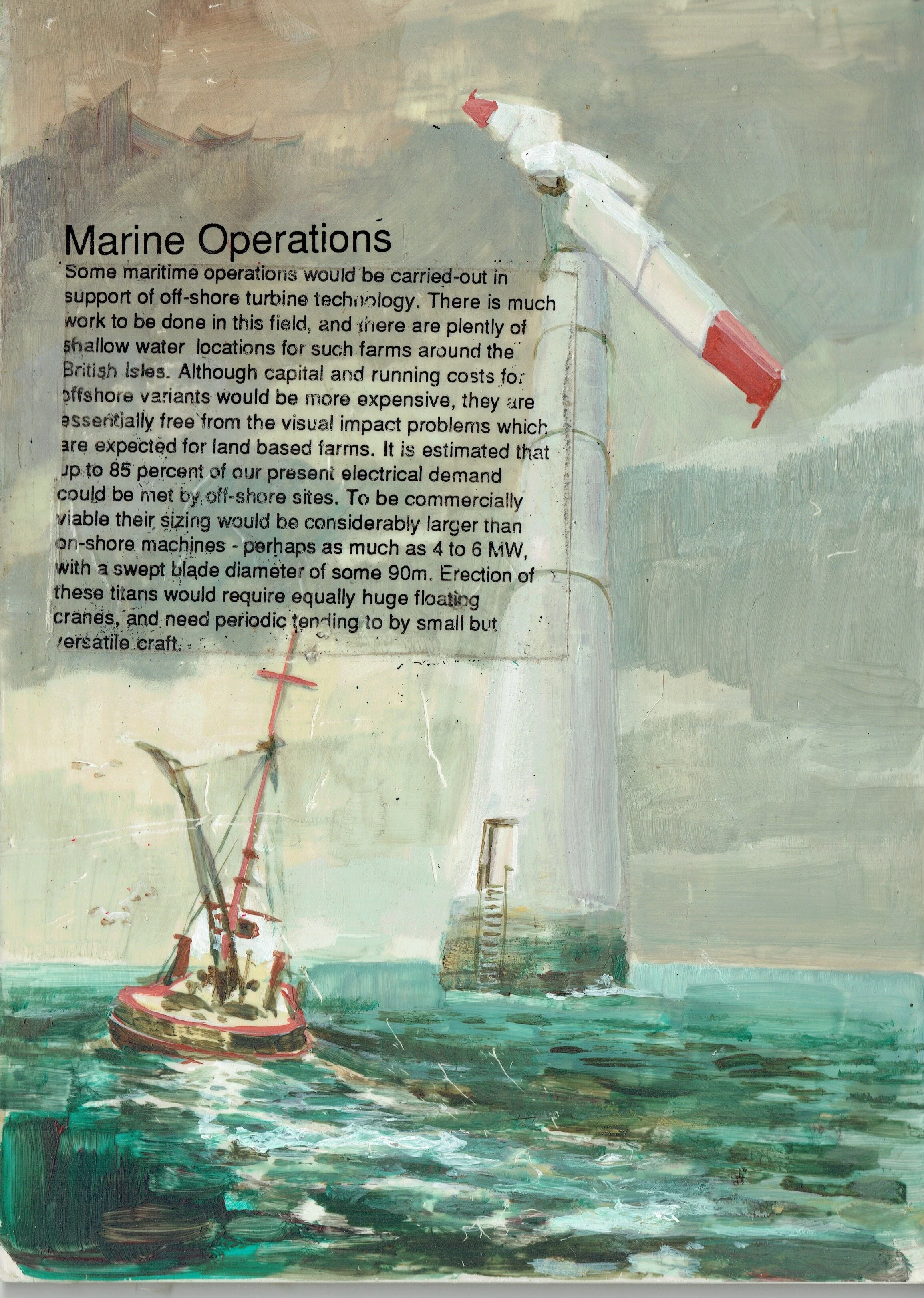
For the thesis project of my fifth year of architectural studies, and now at the Architecture School of Brighton Polytechnic, I was given the latitude to develop my own brief. My idea was to design a research centre for wind energy. My Tutor, David Robson thought he had just the site for such a proposition in Newhaven at the foot of the cliffs and the enormous harbour breakwater.
In the early 1990’s there were no wind farms either on-shore or off-shore and yet it seemed clear to me this was another of those future industries that was sure to play a part in working towards a sustainable society. In my research I stumbled on the fact that the UK had a staggering three-quarters of the European wind resource within its land mass and territorial waters. With forty years of hindsight, it is utterly depressing that UK companies just didn’t believe enough in that future to put the necessary investment in. As such, pretty much all the wind farms in the UK use overseas technology – it is a multi-billion-pound industry.



What should a research and development centre for wind energy be composed of? That was the main question my early research into the thesis project needed to answer. I determined that it should have office and laboratory space, an observation tower, some overnight accommodation, an interpretation centre for the general public as well as a marshalling yard and workshop space for assembling and maintaining the turbines. The laboratory space was raised above the workshop space and included an enormous wind tunnel which had a lowerable testing rig which could then be accessed and set-up at ground level.
This project was the first time I really started to get interested in creating micro-climates for convivial human habitation. In later years, I would develop more sophisticated strategies for ‘climate defensive layering’ such that each element of the surrounding landscape and the building envelope itself would play an iterative role in reducing the harsh extremes of climate. One of my points of departure was observing the old and super tight streets of Hastings ‘old town’ and the Laines of Brighton (or ‘Brighthelmstone’ as it was called when it was just a diminutive fishing village). In effect the tightness of the external spaces between the enclosing buildings created a wind shadow in an otherwise super-exposed location.
The outer defensive layer of the proposal was a beach shingle wall which drew from the language of coastal defences of Martello Towers and the sea forts off Portsmouth. This would do the bulk of wind deflection but also protect the softer fabric of the inner built forms from projectile beach shingle which is a real issue for coastal sites near the tidal zone during storms. Once inside the outer defensive ring, timber framed parallel wings of accommodation were formed around well protected courtyards which were open to the sun but shielded from the wind.



Retrospective Futures 2
A repost to the age of the commuter
I realised that a good many of my degree and diploma level projects had plenty of future thinking into the issues surrounding sustainability and the built environment. I thought the material was worthy of dusting off, digitising and celebrating as a series of retrospective future thinking posts for the Sustainababble blog. This project from 1989 challenged the notion of the daily commute and foresaw the energy saving and quality of life improving benefits of teleworking.

Above: Study for the Golden Square elevation of the entry for the British Steel ideas competition for a headquarters building for information technologists, 1989.
Preface
I realised that a good many of my degree and diploma level projects had plenty of future thinking into the issues surrounding sustainability and the built environment. I thought the material was worthy of dusting off, digitising and celebrating as a series of retrospective future thinking posts for the Sustainababble blog. This project from 1989 challenged the notion of the daily commute and foresaw the energy saving and quality of life improving benefits of teleworking.

Above: 1:100 scale vertical section through the competition entry for a headquarters building for information technologists. 1989
Headquarters Building for Information Technologists, Golden Square, London, 1989
My third-year thesis project was an entry for the British Steel competition for a Headquarters Building for Information Technologists. The site was Golden Square in London and it had a well-considered brief with a fully worked-out schedule of accommodation. Our tutors pushed us off to study celebrated case studies like Lasdun’s HQ for the Royal College of Physicians or Wornum’s HQ for the Royal Institute of British Architects. My preoccupations though were more concerned with lowering environmental impact.
In 1989 it felt like a whole new era was about to unfold – the Information Age. Why then, I asked, did the headquarters building need so much office space in the brief of accommodation? Surely information technology could allow much of the staff to work remotely from home. Along with the notion that the building itself should be a veritable power station of renewable energy, my entry was based on the premise that it had next to no office accommodation because all the staff could telework. Instead, it would be a social and ceremonial hub, a vast I.T. database and all coalesced into a dramatic internal and external set of spaces which would invite the public into the workings of this new institute.

Above: Development sketch of ideas for power tower rising high above the infill site. Coined a ‘sky harvester’, stacks of vertical wind turbines would capture ambient energies from the atmosphere.
On the one hand the architectural concept was all about making the building into a renewable energy power station whereas the more fundamental questioning of the commuting lifestyle suggested that far greater energy saving potentials were possible by looking beyond the building’s envelope and gadgets of energy generation and into the realms of planet-friendly live/work strategies.
This project has particular resonance for me as it informed many of the projects, I would go on to speculate on through my BBM years, like Cityvision and Comstation which were all hypothetical. That notion that we should move away from lifestyles so reliant on stupendous levels of transport mobility also found traction in BBM’s first built project back in 1993 / 94 with Futurehouse with its dedicated homeworking space and a few years thereafter coming up with some of the competition winning ideas behind the Greenwich Millennium Village, working alongside HTA Architects and Ralph Erskine. During the initial Covid outbreak of May 2020 it also formed the basis of my revamp of Cityvision in a RIBA Journal competition entry entitled, Teleworking Cities of Tomorrow. In many ways, the ideas have now come to pass and remote working and less commuting is for many of us now a reality.

Retrospective Futures 1
A rusting hulk of motor-culture
I realised that a good many of my degree and diploma level projects had plenty of future thinking into the issues surrounding sustainability and the built environment. I thought the material was worthy of dusting off, digitising and celebrating as a series of retrospective future thinking posts for the Sustainababble blog. This project from 1988 looked forward to the demise of fossil fuel burning motor vehicle culture.

Above: Sheep were used in the imagery of the motorway service station as a metaphor of the collective madness of a society so utterly hooked on mobility and burning carbon.
Preface
I realised that a good many of my degree and diploma level projects had plenty of future thinking into the issues surrounding sustainability and the built environment. I thought the material was worthy of dusting off, digitising and celebrating as a series of retrospective future thinking posts for the Sustainababble blog. This project from 1988 looked forward to the demise of fossil fuel burning motor vehicle culture.

Above: 1:500 scale model of the final project for a motorway service station
Motorway Service Station, Kent, 1988
Our second-year tutor at the Canterbury College of Art’s Architecture School, Charles Neale dreamt-up an intriguing brief for our main project of the year. The Channel Tunnel was under construction and Charles reckoned there was a need for a motorway service station to act as something of a gateway for travellers entering or re-entering the United Kingdom. In a way, this was a celebration of motorcar culture but almost immediately I started to struggle with what my approach to the brief should be. A breakthrough came when I hit on the idea that the facility should be conceived as a rusting hulk of motor-culture; a disintegrating machine stranded in a Kentish field. For me it became an epitaph to a by-gone age, an age, which was to me, so clearly out of balance with the sustaining capacity of the Earth.

For me the motorway service station had to become an epitaph to the by-gone age of the fossil fuel burning motor vehicle, an age, which was to me, so clearly out of balance with the sustaining capacity of the Earth and what we woud later collectively associate with the culture of ‘peak oil’.

Above: Above: The Motorway Service Station was conceived as a working facility, it’s just that its external architectural handling came loaded with connotations of decay whilst a transient installation (fuelling consumer greed) occupied the interior.

The Dasgupta Review and the Economics of Biodiversity

“If we care about our common future and the common future of our descendants, we should all in part be naturalists.”
Dr. Sir Partha Dasgupta, The Economics of Biodiversity: The Dasgupta Review, Feb. 2021
Image source: Author
I had a quick look through the Dasgupta Review which was published on the UK Government website on 2nd February. Dr. Sir Partha Dasgupta has put some 40 years of thinking behind this report which attempts to examine the economics of biodiversity. This is a clever and brave piece of work. Clever in how it tries to communicate an incredibly complex subject matter that interconnects with every corner of human existence on the planet. Brave in sticking to his long-held belief in the face of a dismissive cohort of economic experts who for years have peddled the myth of sustainable economic growth without environmental consequences. He proposes that we discard ‘gross domestic product’ as a measure of ‘growth’ and start to fold in a fair and equitable economic value of our take of the world’s natural capital. He suggests for example that the Amazon rainforest should be given an economic value for acting as the ‘world’s lungs’ and that we all pay towards its safeguarding. What I think is particularly brave is that Dr. Dasgupta tackles population in his methodology. It is a subject area we hear far too little about in sustainability circles as so few experts have the courage to bring it up. If we are serious about responding effectively to the climate emergency, world leaders better be talking about it at COP 26 in Glasgow. As Dr. Dasgupta said in his report, “…even the recent 2015 Paris Agreement on climate change made no mention of population”.
“We may have increasingly queried the absence of Nature from official conceptions of economic possibilities, but the worry has been left for Sundays. On week-days, our thinking has remained as usual.”
Dr. Sir Partha Dasgupta, The Economics of Biodiversity: The Dasgupta Review, Feb. 2021
The Economics of Biodiversity: The Dasgupta Review, stands on the shoulders of a fair few other thinkers on the subject. Ian McHarg for instance talked about nature doing the work of man in his hugely influential book Design with Nature which was published way back in 1968. In more recent times and from a slightly different angle, Hawkins, Lovins and Lovins in their book Natural Capitalism (1999) argued a similar line to Dasgupta pointing out that the traditional system of capitalism "…does not fully conform to its own accounting principles. It liquidates its capital and calls it income. It neglects to assign any value to the largest stocks of capital it employs – the natural resources and living systems, as well as the social and cultural systems that are the basis of human capital."

Is Boris’ Ten Point Plan to a Low-Carbon Future 28 Years Too Late?
In November 2020, the UK Government, realising that much tougher action on climate change needs to be adopted, published, The Ten Point Plan for a Green Industrial Revolution. Does this plan go far enough? Will it create the green shift we need to achieve true socio, economic and environmental sustainability?

December 2020
In November 2020, the UK Government, realising that much tougher action on climate change needs to be adopted, published, The Ten Point Plan for a Green Industrial Revolution. From a vantage point of 28 years ago, when sustainability issues were showing themselves to be a burgeoning problem through the Rio Earth Summit, there was very little interest, let alone political will, to take meaningful mitigating action. If this plan had been drawn up then, what an amazing positive prospect that would have presented. The issue we have now though is that we have eaten into 28 years of our remaining carbon expenditure budgets, the ones which we hope will allow us to avoid catastrophic climate change, and the challenge of meeting those targets is a lot harder to do now than it was back then. Does this plan go far enough? Will it create the green shift we need to achieve true socio, economic and environmental sustainability?
As soon as it was published, environmental campaigners decreed this new green plan did not go far enough. Some highlighted that the plan’s £5 billion budget was witheringly small when compared to the contemporary road building budget of £27 billion and that this underlines how reluctant Government is to not rock the business-as-usual boat too much. Indeed, they are trying to sell the vision by suggesting we can keep our lifestyles more or less as they are, but all our trappings of convenience will be powered by greener technologies,
“We will use this energy to carry on living our lives, running our cars, buses, trucks and trains, ships and planes, and heating our homes while keeping bills low.”
The plan is predicated on the notion, “…to build back better”. That is of course driven by the economic compression of the Coronavirus pandemic. It also invokes one of the other key commitments of the Government’s manifesto, to utilise this green shift as a driver for “levelling up the country”. Its architects identify it as a Green Industrial Revolution, aligning its’ heritage to the first industrial revolution, some 200 years ago, which, as we were all taught at school, is proudly attributed as a UK-led innovation.
So, what is the plan?
The plan consists of the following strategic sections of activity and whilst there are some sustainability issues which do not get a mention, the overall breadth of policy approach is to be commended.
Point 1
Advancing Offshore Wind
Point 2
Driving the Growth of Low Carbon Hydrogen
Point 3
Delivering New and Advanced Nuclear Power
Point 4
Accelerating the Shift to Zero Emission Vehicles
Point 5
Green Public Transport, Cycling and Walking
Point 6
Jet Zero and Green Ships
Point 7
Greener Buildings
Point 8
Investing in Carbon Capture, Usage and Storage
Point 9
Protecting Our Natural Environment
Point 10
Green Finance and Innovation
Point 1
Advancing Offshore Wind
Kicking off with offshore wind is an easy one. For the UK, offshore wind holds the promise of a lot of quick wins and it is politically is easier to sell than some other alternative technologies. As an island nation we do have a lot of coast, large areas of surrounding shallow seas and an estimated three-quarters of the available European wind resource. This is big engineering which not only creates jobs for the manufacturing and installation phases but also for the not inconsiderable ongoing maintenance of the arrays. The plan suggests support for up 60,000 jobs, securing around £20 billion of private investment and savings of 21MtCO2e (metric tonnes of CO2 equivalence for all greenhouse gas emissions). It is interesting that onshore wind and solar get a tiny mention, being eligible for Contract for Difference (CfD) finance.
Notably in David MacKay’s book, Sustainability Without the Hot Air, published in 2009 which looked at a number of energy scenarios for the UK, His Plan G, the one most heavily reliant on wind energy, assumed a total wind energy sector of around 80GW.[i] The new plan has a target for 40GW of offshore wind energy.
Point 2
Driving the Growth of Low Carbon Hydrogen
Low Carbon Hydrogen is more of a gamble. Much of the technology is still theory and it will likely be very costly to roll out even once the technical solutions are available. Hyrdogen fuel might be part of a heating mix for residential and non-residential buildings complimenting electrically driven heat pumps. Heat pumps are expensive, particularly ground source heat pumps and the cheaper air-source heat pumps are not effective at delivering domestic hot water in the colder months. In fact, until grid electricity is more completely decarbonised, super-efficient gas boilers are probably more carbon beneficial than most heat pump installations. Hydrogen fuel might also be a way of replacing fossil fuels for use in sea and air travel.
Point 3
Delivering New and Advanced Nuclear Power
Nuclear power is part of the plan. This is recognition of the fact that we need, “something easily turn-off-and-onable…and a big something”, as David MacKay termed it in his book, Sustainable Energy Without the Hot Air.[ii] We need a reserve of base-load power to kick-in when the ambient sun and wind energy available is low and when demand potentially could be high. That reserve then needs to switch off quickly if say the wind starts to blow and the clouds part. This is coping with demand lulls and slews and the plan thinks nuclear could play a key role in providing this turn-off-and-onable base load. The Government is already pursuing large-scale nuclear (subject to value for money) but is interested in looking at small modular reactors. Such small-scale reactors are seen as being factory manufactured and then assembled on site. Notably there are no MW targets of delivery confirmed in the plan.
Point 4
Accelerating the Shift to Zero Emission Vehicles
With zero emission vehicles, the Government has had a bit of a dramatic and welcome rethink and brought forward the previous phasing out date of petrol and diesel burning cars by 10 years to 2030. Hybrids will be allowed for sale up until 2035 which probably recognises that some communities may not get the car-charging infrastructure in place for many years to come. The Government see this as one of the more obvious linkages of job creation and greener forms of living. It is also one of the ways to most quickly improve the air quality of our towns and cities. There is a high-profile inquest ongoing whereby a nine-year-old girl died in 2013 from respiratory issues linked to local air quality around her home near the South Circular Road in the London Borough of Lewisham. China has already transitioned all its buses and taxis to electric only and it is illegal to have a petrol driven motorbike in Chinese cities.
Electric vehicles though are not a panacea for a sustainable economy. A nation reliant on EV-cars will massively increase the demand for electricity, thus making the energy generating strategy that much more critical and more challenging to achieve. We must not lose sight of the environmental damage of mining the minerals needed for battery manufacture. There is talk of scouring the seabeds of the globe to find these rare earth resources, a prospect of potentially horrifying environmental consequences that we can barely begin to predict.
Point 5
Green Public Transport, Cycling and Walking
It was H.G. Wells who once said,
“Every time I see an adult on a bicycle, I no longer despair for the future of the human race.”
It is heartening to see the fifth point of the plan is green public transport and specifically cycling and walking, something the plan calls, “active travel”. We all know that Boris Johnson is a keen advocate of the bicycle and here the plan has credible strategies for really positive change. There is a proposal to create a new body to help deliver the implementation, Active Travel England.
The plan acknowledges the link to improving not only air quality with a strong walking and cycling transport strategy but also capitalising on the lateral benefits of improving mental and physical well-being when participating in such ‘active travel’.
Most of the budgeting announced in the plan seems to be earmarked in this section for investments in public transport, notably enhancements and renewals of the rail network and buses. Surely, we should put more focus in the plan to look at ways in which society can operate with far less reliance on physical transport. Towns, villages and cities need long-term regeneration to operate more completely on pedestrian and cycle modes of transport – liveable and walkable conurbations are often the most desirable places to live.
The Covid lockdowns have woken us up to the potentials of remote working (see my earlier blog, Teleworking Cities of Tomorrow). As much of this plan would have been written during the Covid-crisis, it is disappointing that there is not more recognition of the need to rethink how we will use the rail and road networks in future. It may well be that we should not maintain some aspects of the rail network as we have been used to. It just won’t be financially viable if so many of us are not going to commute as much as we once did. Perhaps commuter trains should be reengineered to work as two coach units rather than predominantly four or five. This would make them more responsive to lighter demand and afford much-needed savings in expended energy. There is short term concern about the viability of the traditional central business districts of our major cities which have operated like ghost towns since late March 2020. It should be argued that this zonal planning model is no longer fit for purpose. Such places were devoid of life anyway on weekends which belied the fact that they were unhealthy areas of urban fabric. There is a strong parallel here to large-scale monocrop farming. We need far more biodiversity in our farming practices and our towns and cities should be reinvigorated to be a healthier mix of living, working and learning in close proximity.
Point 6
Jet Zero and Green Ships
The plan attempts to tackle aviation and shipping which are very challenging nuts to crack in terms of making them more honestly fit within our carbon reduction budgets. Most of the ideas seem to be based around the notion of developing hydrogen fuel at scale for both ships and planes. The UK has built much of its recent economic activity around aviation both in terms of manufacturing of planes and aero engines and in operating airlines and airports. Many decades ago, the UK was once a great maritime power too with large fleets of merchant and naval vessels and large parts of the economy geared around their design, manufacture and salvage. For an island nation, it is odd that we gave up so completely on shipping. Poor industrial relations and lack of management vision and investment were largely to blame. So, it is interesting to see a “Clean Maritime Demonstration Programme” being touted in the plan and being largely based around emerging hydrogen fuel cell technology. The energy and pollution costs of shipping often get missed off in people’s comprehension of societal environmental impact but they are significant. Jon Stone in the Independent writes,
“Sea transport accounts for around 3 per cent of the UK's emissions, but is currently not included in climate targets, despite repeated recommendations from the government's own experts that it should be.”[iii]
We must remember that the production of hydrogen fuel will release carbon. Is it feasible that we can make marine and aviation transport carbon neutral?
Perhaps in a post-Brexit UK, the economy should be made less reliant on globalised supply chains and look to bring back some of the industry it has outsourced over the past half century. However, to achieve a net-zero carbon economy, this plan needs to think about carrot and stick strategies for reducing our addiction to non-essential travel.
Point 7
Greener Buildings
For years, the UK Government has looked to the built environment sector as the low-hanging fruit of energy saving and the seventh point of the plan is Greener Buildings. If we step back for a moment to understand why, we can appreciate that by reducing the demand for energy by for instance making buildings more energy efficient to heat, we can reduce the amount of energy we need to find from green or fossil fuel sources.
There is no mention of the Government’s earlier slogan of “build, build, build”, but policy makers need to catch up with the notion that the very process of constructing buildings is a massive carbon impact in its own right. The industry itself is getting to grips with how to model and tweak what is known as ‘embodied carbon’ in their design work, but it is complex and excruciating stuff. The idea that we can build ourselves out of a deep economic recession, fills those in the know about embodied carbon with environmental dread. Organisations like Architects Climate Action Network (ACAN) have described this get Britain building knee jerk as a “carbon burp”. Moreover, the recent Government white paper looking at reforms to speed up the planning system broadly in favour of development appears completely at odds with the checks and balances needed to ensure that developments are designed fit for the environmental challenges of the next century. Of course, there is a crisis in the supply of housing but that can largely be put down to a lack public investment in social housing, and let us be honest with ourselves, that is a result of the 35 year old but still popular ‘right to buy’ legislation. Beyond that is the biggest elephant in the room, at some point leaders have to start tackling a global and local managed population decent but that is a topic too big to tackle in this review of the Ten Point Plan.
Point Seven is worryingly light on discussion around the upgrading of existing building stock. It is that old chestnut of an issue that two thirds of the buildings we will have in 2050, already exist. Policy makers, it would appear, are still reeling and scratching their heads over the ill-fated Green Deal programme. It is very hard to get people to invest in energy efficiency measures on their properties as the pay-back period is usually far longer than they can expect to be in the property. Moreover, technically sound eco-retrofit is not any easy to thing to get right and many architects are reluctant to design such projects as the risks and fees are not commensurate with the project’s design complexities, especially post-Grenfell. It remains to be seen if the new PAS2035 standard will help improve matters in this regard (See my earlier blog, Top Tips for Eco-Retrofit).
Point 8
Investing in Carbon Capture, Usage and Storage
Point eight concerns itself with carbon capture, usage and storage (CCUS). There is a high-tech version of carbon capture which is a technology which is not yet fully proven at scale and there is a low-tech version that we are all familiar with, growing trees. Here the plan talks about the establishment of four industrial clusters it coins, SuperPlaces which are intended to bring together carbon capture and hydrogen projects as part of a new business model. In short, carbon capture will help mitigate ongoing fossil fuel burning, part of the mix when equating a ‘carbon neutral’ status for development. As an economic strategy it is trying to position the UK’s industry to be competitive within an anticipated global net-zero carbon economy. The goal is to capture up to 10Mt of carbon dioxide per year by 2030.
Point 9
Protecting Our Natural Environment
It is disappointing there is no overt acknowledgment in Point 9, which itself deals with the natural environment, that there is a bio-diversity collapse going on around us. The report comes across more as a strategy to conserve the romantic notion of the rural landscapes of Britain. That said there are some good strategic plans to be proactive in safeguarding and restoring habitats, rewilding and creating new national landscapes (new national parks and AONB’s), with some post-Brexit planning in the form of replacing EU land management funding.
What should be acknowledged, and which also relates back to the planning system, is how in recent years simple building projects have been bogged down in sometimes hugely expensive ecological surveys which hardly ever result in a development being stopped or in producing significant net gain of biodiversity. What should be included is an overt project to buy back farmland which is proven to be worked in environmentally damaging ways and rewild these as nature reserves of regional significance. The funding for this could be levied from planning applicants but this should not be seen as additional cost. Whilst some types of ecological surveys are hugely important, it is arguable that some are more to do with box ticking in accordance with the survey standards (typically BS42020) and do not necessarily lead to ecological enhancements. In such cases it would be more meaningful for planning application to contribute towards a form of eco-land banking towards increasing eco-system services.
Industrialised farming practices should be scrutinised and assessed in terms of overall environmental impacts, including use of fossil fuels, fertilisers, pesticides and land use biodiversity. There should then be a financial carrot and stick framework to help level up the costs of more environmental farming techniques.
Point 10
Green Finance and Innovation
The 10 Point Plan must be commended for projecting positivity in its’ suit of policy proposals and Point 10 completes the plan with ideas to create the green technology innovation and the incentives for free-market investment into green sectors of the economy. It proposes a Net Zero Innovation Portfolio which effectively will translate each strand of the 10 Point Plan into commercialisation. In particular it highlights the need to boost development of the riskier technologies like direct air carbon capture and that ever-tantalising prospect of nuclear fusion energy generation.
To help deliver the green industrial revolution, it recognises the need to upskill the workforce and propose the launch of the Green Jobs Taskforce to help achieve this.
Perhaps though this plan needs to be bolder. Governance of the free-market sector needs to step-up to steer consumer-focused industries away from overtly polluting and energy hungry product manufacture and service delivery as well as root out wasteful packaging practices. The last three decades have proved that private sector industry alone rarely does it of their own volition. 28 years on from the Rio Earth Summit, we no longer have the luxury of time to see if business can be left to do the right thing.
[i] MacKay, David, Sustainable Energy Without the Hot Air, UIT Cambridge Ltd, 2009. Pg. 210
[ii] MacKay, David, Sustainable Energy Without the Hot Air, UIT Cambridge Ltd, 2009. Pg. 186
[iii] https://www.msn.com/en-gb/news/uknews/labour-urges-government-to-include-international-shipping-emissions-in-co2-targets/ar-BB1bsOBG?item=personalization_enabled%25253Afalse&%2525253Bfdhead=intl30ip